Warning: Undefined variable $url in /home/undiscov/public_html/undiscovereditaly/wp-content/plugins/twitter-facebook-google-plusone-share/tf_display.php on line 365

Crazy Good Wine in Umbria

Crazy Good Wine in Umbria

Round trip airfare for two to Rome: $1410. Eight nights at an agriturismo near Montefalco: $750. Spending an afternoon with Giampaolo Tabarrini: priceless.

The seeds were planted at Slow Wine Italy’s February trade show in Manhattan, where I met Daniele Sassi, Azienda Tabarrini’s PR and marketing director. He insisted that a planned viaggio di vino in Umbria must include meeting the winery’s head man, adding that his compadre “is a little crazy.”

Tabarrini is crazy all right… like a fox. He’s a dynamo of passion and enthusiasm, bursts of energy flying from him like atoms in a reactor. Proudly showing us the work in progress that will make his cellar the area’s largest, he explains that space is needed for the long-term projects and creative ideas fermenting in his restless mind. He’s the shark who must keep moving or expire, always trying, as he puts it, “to move forward and step up to the next rung of the ladder. This motivates me to push my work to the next level every time.”


Which explains taking a chance on Grero, one of those rediscovered grapes that keep popping up in Italy. A decade ago Tabarrini’s DNA research showed it to be an indigenous varietal and he gave it a shot. “Clearly in Umbria we have unique native grapes that are different from anywhere else,” he adds. “My work is bound to them and to the context of Montefalco.”

The result is Piantagrero, a not-yet-released, 100% varietal stunner he defines as a versatile wine. As Sassi pours from an unlabeled 2015 (one of only a hundred made), I ask Tabarrini where he hopes to go with this oddball grape. “It’s not going to be us taking Grero anywhere in particular, but rather it taking us somewhere new. When the wine is special, it’s the wine that will lead us somewhere.”

Destination unknown, it’s weirdly appealing and geeky. Sassi calls the vibrant reddish-purple color psychedelic, and it certainly resembles a high school lab experiment gone haywire. Unlike most reds, Piantagrero is vigorously fruity and highly acidic, an unusual combo of tingling mouthfeel and savory ripeness. There’s nothing to compare to this quirky brainchild of Montefalco’s excitable boy, who calls it the “natural evolution of traditional winemaking to becoming a maverick.

“My wines and I have the same character,” he continues. “They come from my way of thinking and taste… They mean a lot to me… They are my creatures.”


Grero’s story may be uncertain, but that of Tabarrini’s Sagrantino has been written. A fourth generation winemaker, he was the first in Umbria to bottle single vineyard Sagrantino in 2003. He believes that “the single vineyard concept is absolutely the most interesting thing we can do in wine. Noticing that the same type of grape can be so drastically different when it’s coming from single vineyards makes me think there can be different versions of the truth.”

The truth is that he makes his three expressions of Sagrantino the same way, eliminating the variables to showcase variations in altitude, exposure and, as he points out, especially the soils.

Tabarrini pulls no punches about his flagship grape. “Sagrantino is a great wine. I can easily put it among the five or six best wines of Italy. People in other regions have started to realize the wines can’t age as well… When it’s young, it’s surely difficult, but even a 2010 already has smoothness and depth. This lets me think that bottle will have a great evolution, like a Barolo would from a great producer.”


The Sagrantino we taste validates his single vineyard theory. Colle Grimaldesco is beautiful, the least broad shouldered of the three. a balance of elegance and rich flavors of cherry and blackberry in a firm tannic structure. Colle alla Macchie is the big bad wolf of the trio that blows me away with its muscle and woodsy, tarry depth. Campo alla Cerqua is the bruiser, a wallop of power and finesse, Muhammad Ali in a bottle. Warmth, depth and complexity make it a Sagrantino for veterans of the vine. There’s already a lot going on, but time is on its side. To my mind, Tabarrini’s best.

Afternoon turns into evening as we pass around plates of house-cured charcuterie and homemade bread brought to the table by Tabarrini’s parents. Chatting and drinking with two cool guys. It just doesn’t get any better, at any price.

Top image by Mike Madaio. All others via Tabarrini Facebook.


When Less Is More

When Less Is More

Planning an itinerary for a week along Montefalco’s Strada del Sagrantino should be a breeze. With a cantina around every bend in the road, there are certainly enough choices. That’s the problem – so many wineries, so little time. Booking visits at well known places is a sound strategy, but there’s the chance of missing some hidden gems. So, what cosmic force led me to Azienda Francesco Botti? A website that featured a quote from Virgil: “Praise a large estate but cultivate a small one.” A winemaker with an appreciation of the classics was someone I had to meet.

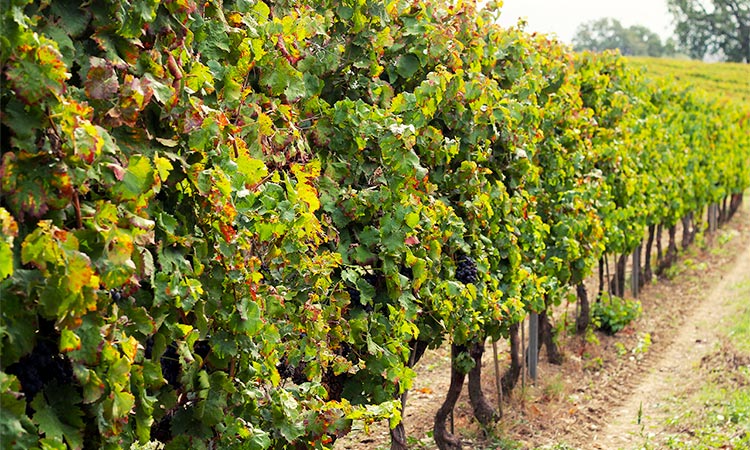
Francesco Botti isn’t a poet or philosopher, just content to be sole operator of Colle del Saraceno. He cultivates only a portion of nine hectares (22 acres) on the western slope of the valley that bisects Umbria, land that has been in the family for over a century. As we sat on a shaded veranda overlooking vines and olive trees, Francesco poured his four wines as his assistant Monica translated. He makes about 2800 cases a year and has no desire to expand, or compete with neighbors who routinely have busloads of wine tourists at their door. “Staying a small producer I can respect nature and its cycles, I can maintain the traditional essence using modern techniques.”

Had he ever thought about hiring a consultant? “My wines have to be the expression of my character, of my ideas, but I can only interpret what every season offers me. I prefer to make my wines by myself. Every year is a challenge, and what the market wants is important but it cannot decide in place of me. An enologist would only suggest the best wine for selling!” He went on to say he wanted his wines to represent his little corner of Montefalco, that consultants sometimes have an identifiable style that can be repeated anywhere.

Giving our glasses of an aromatic Sagrantino time to open, I wanted to get his thoughts on what is important in making wine, and his connection to the land. “I was born among olive trees and vineyards and I felt that nature had to accompany me in my life. So I think the most important thing in making wine is the passion and seriousness which guided me in the difficulties I found along my human and professional paths.”

The discussion turned to Sagrantino being a hard grape to understand and warm up to. Francesco agreed, adding that “…it has a thick skin and bold tannins. Our wines have to withstand strong climatic stress all year from long winter to hot, dry summer. They need to have character, the same character you will find in their fragrance, body and structure. To know Sagrantino you must learn where it is born, lives and grows and the vegetation all around. Only after this you can say you know it.”

The 2012 we were drinking had character to spare, and Francesco’s low key thumbprint was evident. Unfiltered and unrefined, it wasn’t a punch in the mouth or a kiss on the cheek, more a balancing act of power and finesse, of density and structure. A good middle-of-the-road introduction for newbies to a grape that can be ornery. It would be interesting to see what it will be with five to ten years of cellaring.

Author’s note: When you reach a certain age, time may be the wine’s friend, but not yours. I plan to open the bottle that Francesco gave me this autumn!  

The artisanal wines of Colle del Saraceno make a personal statement. They are as serious, direct and unassuming as their creator. Grechetto 2015 was lively and savory, far better than many I had on the trip that were basically forgettable house wines that come in a quarto. It was a literal and figurative eye opener at 10:30 in the morning. Galdino is a proprietary blend of mostly Sagrantino with Sangiovese, Cabernet and Merlot. Francesco doesn’t adjust the percentages from year to year, in contrast to what seems a common practice used to maintain product consistency. As he pointed out, “The wine will change anyway because each season is different.” The proof was in front of me, successive vintages that couldn’t have been more unalike. A duo of smooth, darkly fruity and rich Sagrantino Passito topped off the morning. The older one had the elegance and depth of a vintage Port, the other more like a Tawny that needs time to grow up and fill out. Francesco hopes that his wines “…tell about the land they come from, wonderful and welcoming but hard and reserved at the same time.” On that score he has nothing to worry about.

On the way back , I pictured Virgil sharing a bottle with him, praising his small estate and contemplating the winemaker’s words: “If you learn to listen to nature, every day it teaches you something about life.”

all photos via http://www.cantinabotti.com/

What Exactly is Trebbiano?

tabarrini-adarmando

The second most commonly planted grape in Italy — Trebbiano – does not exist. Not without a modifier, at least. Trebbiano Toscana is real. So is Trebbiano Giallo. And Trebbiano Spoletino. The family is quite large, actually, with endless varieties grown all over Italy and beyond. Yet genetic research shows that the Trebbiano children do not share the same parents. In fact, the only definitive finding of a 2001 genetic study on the Trebbiano grapes – as well as some similar grapes from different families  – was that Trebbiano di Soave and di Lugana are actually Verdicchio.

Read the full article on Palate Press