Warning: Undefined variable $url in /home/undiscov/public_html/undiscovereditaly/wp-content/plugins/twitter-facebook-google-plusone-share/tf_display.php on line 365

One Great Bottle: Fiamberti Oltrepò Pavese Bonarda 2012

bonarda-bricco-della-sacca

I’ve never been a huge fan of Lambrusco, mainly because it can tend towards a cheap candy (think Cherry Chan) flavor profile. Having been exposed to other wine writers and lovers gushing about the sparkling red stuff, however, I’ve tried my best to keep an open mind and sample as many as I can. Perhaps that’s why I took a flyer on this bottle of (non-Lambrusco) frizzante red, just $12.99 at Wines from Italy (out of stock as of this writing).

Confusingly, Bonarda dell’Oltrepò Pavese is made from Croatina grapes, not the variety with which it shares a name. And though a still ‘Bonarda’ can also be made in this new (since 2010) Lombardian DOC, the most common version is naturally sparkling – though only slightly – and features, as the winery puts it (with perhaps something lost in translation) “a peculiar red foam.”

Regardless, Fiamberti Bonarda dell’Oltrepò Pavese Bricco della Sacca 2012 is a fascinating wine on every level. On the nose it comes across as pure old world, with savory, earthy notes, yet on the palate it’s fruity, almost jammy, with a bright freshness accentuated by a touch of effervescence.

Though commonly served with first courses, especially salumi, I went rogue and paired it with chili. That’s right, one of the most difficult wine pairings known to man. Incredibly, perhaps – or knowingly, due to my personal pairing, uh, genius – this wine was an excellent choice for the complex and spicy flavors, as the slight sweetness and refreshing bubbles helped clean my palate after each bite.

#ItalianFWT

This post was part of the May 2017 Italian Food Wine Travel topic on Italian sparkling wine. Here are the other participants:


Q&A: Anthony Vietri of Va La Vineyards

Q&A: Anthony Vietri of Va La Vineyards

As much as I love all things Italy, especially with regards to food & drink, there’s also something abundantly Italian about supporting and utilizing local purveyors, regardless of nationality. The idea of shipping some delicacy halfway across the world, on the other hand, seems to go against the core principles of Italian food culture – local, fresh, seasonal.

This is the circuitous way of saying I support east coast wineries as much as possible, even if my vinous heart lies in Italy. Thankfully, there’s one Southeastern PA vintner – Anthony Vietri – who can offer the best of both worlds. Nestled in the heart of Kennett Square mushroom country (which produces the vast majority of US-grown fungi), Vietri’s Va La Vineyards grows mostly Italian varietals while carrying on the winemaking traditions of his family.

For a more detailed background on the winery, I highly suggest reading Jeff Alexanders wonderful piece, “Grapes and Ghosts of Chester County Wine Country,” which we published here at Undiscovered Italy last week. (Seriously, go. I’ll wait.)

As for now – we recently caught up with Vietri to ask him a little more about his Italian heritage, and how it influences his winemaking and beyond. His responses follow:

Where is your family from in Italy?
My maternal family is from Liguria & Piemonte (Giusvalla+ Malvicino). My paternal family is from Campania (Vietri sul Mare).

What are some of your favorite characteristics of each area?
The food is just wonderful. Wild mushrooms, truffles, chestnuts, and wild game in the north, and the fish, incredible fruits, vegetables, and crystal clear waters in Campania.

What are some of the traditions you still honor from this area and your family?
All of our cooking, although we lean toward the northern influences. Our farming is heavily focused on Piedmontese varieties, chestnuts, etc.

Describe an undiscovered Italian wine region you love.
I lived for a while in a village called Riomaggiore, in Liguria, before there was a road for cars, and I very much loved it there. At the time (1980s), it was still the 19th century. Folks hung from ropes to pick some of the grapes on the cliff terraces. Every morning women would scale the steep hillsides with baskets balanced on their heads, filled with fruit, wine, cheeses, and bread for the men tending to the vines on the terraces.

How about some undiscovered Italian foods ?
Strangely enough, my maternal family was big into Mate, because some of our folk had migrated to Argentina and brought this custom back with them. They foraged wild greens to make it. They also made a sheep cheese called formagiatto, which I remember hanging in a bag over the sink whenever I washed my hands. Also, as farmers, the family foraged a lot, and ate a lot of small wild birds on polenta. To this day, we love to pick a wild green in the spring called poke, which we serve scrambled into eggs or in omelets.

What’s a favorite food pairing with one of your wines?
I love to have La Prima Donna with wild local goose, and oyster mushrooms. Silk with prosciutto crudo, or fresh warm bread dipped in sauce cooking on the stove. Mahogany with lamb chops from Meadowset Farms in Landenberg, PA. Roasted rabbit, and chestnuts from our yard with Cedar. Sorry, I could go on all day…

You grow many Italian grapes (including some rare ones). Were you inspired to do this because of your heritage or because you felt they were best suited to this climate?
Both I suppose, but that is a very long story!

Which grape has surprised you most?
I love all of our babies, but to be honest I would have to say that out of all the varieties that we have grown, Nebbiolo is the one that truly haunts me.

Photos by Jeff Alexander

Colomba di Pasqua

colomba

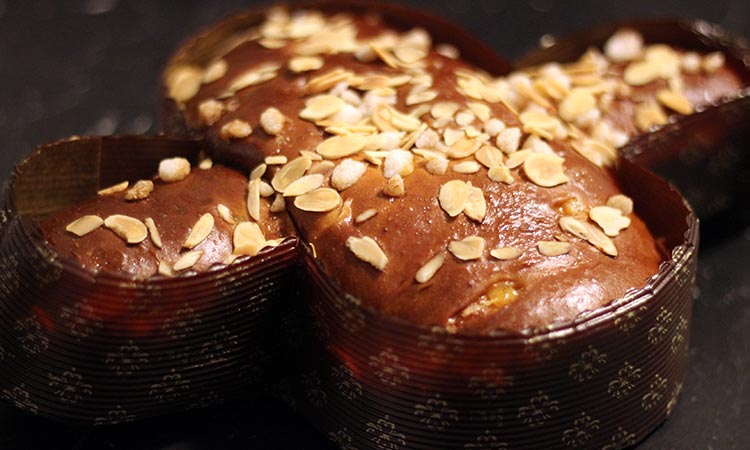
When I heard the April theme for #ItalianFWT was Easter (Pasqua in Italian), I had momentary delusions of grandeur of baking my own Colomba, the traditional Easter bread/cake that’s shaped like a dove. But I quickly came to my senses, as baking is not my forte and I generally lack the time and patience for such an endeavor. Thankfully, a fortuitous trip to my local Italian store, Carlino’s, brought me face to face with a freshly baked Colomba instead. For the low price of just $12.99, fruity, cakey goodness arrived without hassle or strife.


Though the history of Colomba di Pasqua – or Colomba Pasquale, literally “Easter Dove” – like so many other traditional Italian dishes, is disputed, it’s not hard to deduce that the dove shape (which, let’s be honest, this just barely resembles) represents peace. Also without dispute is the fact that Milanese baker Angelo Motta – best known for industrializing the production of Panettone in the 1920s – is responsible for the widespread enjoyment of Colomba.

Other than the obvious difference in shape and lack of raisins, Colomba’s yeast dough is similar to Panettone. For a layman, the flavor profile – candied citrus, mostly – and texture are virtually identical, though levels of sweetness can vary. For an added burst of flavor, the Easter Dove is traditionally topped with almonds and pearl sugar crystals.


Colomba’s arrival at table typically signals the end of Easter lunch — where it can be enjoyed straight up, or perhaps with some berries, whipped cream or chocolate. If there’s a knock on this treat (and Panettone), it’s that the insides dry out easily and can often seem stale. That’s why, for me, the best way to eat either is some butter and a few minutes on the griddle, or even as French Toast, if the particular loaf isn’t too sweet.

I know what I’ll be eating Easter Morning…

#ItalianFWT

This post was featured in the Italian Food, Wine & Travel group’s April theme, Easter in Italy. Here are the other posts: