Warning: Undefined variable $url in /home/undiscov/public_html/undiscovereditaly/wp-content/plugins/twitter-facebook-google-plusone-share/tf_display.php on line 365

Crazy Good Wine in Umbria

Crazy Good Wine in Umbria

Round trip airfare for two to Rome: $1410. Eight nights at an agriturismo near Montefalco: $750. Spending an afternoon with Giampaolo Tabarrini: priceless.

The seeds were planted at Slow Wine Italy’s February trade show in Manhattan, where I met Daniele Sassi, Azienda Tabarrini’s PR and marketing director. He insisted that a planned viaggio di vino in Umbria must include meeting the winery’s head man, adding that his compadre “is a little crazy.”

Tabarrini is crazy all right… like a fox. He’s a dynamo of passion and enthusiasm, bursts of energy flying from him like atoms in a reactor. Proudly showing us the work in progress that will make his cellar the area’s largest, he explains that space is needed for the long-term projects and creative ideas fermenting in his restless mind. He’s the shark who must keep moving or expire, always trying, as he puts it, “to move forward and step up to the next rung of the ladder. This motivates me to push my work to the next level every time.”


Which explains taking a chance on Grero, one of those rediscovered grapes that keep popping up in Italy. A decade ago Tabarrini’s DNA research showed it to be an indigenous varietal and he gave it a shot. “Clearly in Umbria we have unique native grapes that are different from anywhere else,” he adds. “My work is bound to them and to the context of Montefalco.”

The result is Piantagrero, a not-yet-released, 100% varietal stunner he defines as a versatile wine. As Sassi pours from an unlabeled 2015 (one of only a hundred made), I ask Tabarrini where he hopes to go with this oddball grape. “It’s not going to be us taking Grero anywhere in particular, but rather it taking us somewhere new. When the wine is special, it’s the wine that will lead us somewhere.”

Destination unknown, it’s weirdly appealing and geeky. Sassi calls the vibrant reddish-purple color psychedelic, and it certainly resembles a high school lab experiment gone haywire. Unlike most reds, Piantagrero is vigorously fruity and highly acidic, an unusual combo of tingling mouthfeel and savory ripeness. There’s nothing to compare to this quirky brainchild of Montefalco’s excitable boy, who calls it the “natural evolution of traditional winemaking to becoming a maverick.

“My wines and I have the same character,” he continues. “They come from my way of thinking and taste… They mean a lot to me… They are my creatures.”


Grero’s story may be uncertain, but that of Tabarrini’s Sagrantino has been written. A fourth generation winemaker, he was the first in Umbria to bottle single vineyard Sagrantino in 2003. He believes that “the single vineyard concept is absolutely the most interesting thing we can do in wine. Noticing that the same type of grape can be so drastically different when it’s coming from single vineyards makes me think there can be different versions of the truth.”

The truth is that he makes his three expressions of Sagrantino the same way, eliminating the variables to showcase variations in altitude, exposure and, as he points out, especially the soils.

Tabarrini pulls no punches about his flagship grape. “Sagrantino is a great wine. I can easily put it among the five or six best wines of Italy. People in other regions have started to realize the wines can’t age as well… When it’s young, it’s surely difficult, but even a 2010 already has smoothness and depth. This lets me think that bottle will have a great evolution, like a Barolo would from a great producer.”


The Sagrantino we taste validates his single vineyard theory. Colle Grimaldesco is beautiful, the least broad shouldered of the three. a balance of elegance and rich flavors of cherry and blackberry in a firm tannic structure. Colle alla Macchie is the big bad wolf of the trio that blows me away with its muscle and woodsy, tarry depth. Campo alla Cerqua is the bruiser, a wallop of power and finesse, Muhammad Ali in a bottle. Warmth, depth and complexity make it a Sagrantino for veterans of the vine. There’s already a lot going on, but time is on its side. To my mind, Tabarrini’s best.

Afternoon turns into evening as we pass around plates of house-cured charcuterie and homemade bread brought to the table by Tabarrini’s parents. Chatting and drinking with two cool guys. It just doesn’t get any better, at any price.

Top image by Mike Madaio. All others via Tabarrini Facebook.


When Less Is More

When Less Is More

Planning an itinerary for a week along Montefalco’s Strada del Sagrantino should be a breeze. With a cantina around every bend in the road, there are certainly enough choices. That’s the problem – so many wineries, so little time. Booking visits at well known places is a sound strategy, but there’s the chance of missing some hidden gems. So, what cosmic force led me to Azienda Francesco Botti? A website that featured a quote from Virgil: “Praise a large estate but cultivate a small one.” A winemaker with an appreciation of the classics was someone I had to meet.

Francesco Botti isn’t a poet or philosopher, just content to be sole operator of Colle del Saraceno. He cultivates only a portion of nine hectares (22 acres) on the western slope of the valley that bisects Umbria, land that has been in the family for over a century. As we sat on a shaded veranda overlooking vines and olive trees, Francesco poured his four wines as his assistant Monica translated. He makes about 2800 cases a year and has no desire to expand, or compete with neighbors who routinely have busloads of wine tourists at their door. “Staying a small producer I can respect nature and its cycles, I can maintain the traditional essence using modern techniques.”

Had he ever thought about hiring a consultant? “My wines have to be the expression of my character, of my ideas, but I can only interpret what every season offers me. I prefer to make my wines by myself. Every year is a challenge, and what the market wants is important but it cannot decide in place of me. An enologist would only suggest the best wine for selling!” He went on to say he wanted his wines to represent his little corner of Montefalco, that consultants sometimes have an identifiable style that can be repeated anywhere.

Giving our glasses of an aromatic Sagrantino time to open, I wanted to get his thoughts on what is important in making wine, and his connection to the land. “I was born among olive trees and vineyards and I felt that nature had to accompany me in my life. So I think the most important thing in making wine is the passion and seriousness which guided me in the difficulties I found along my human and professional paths.”

The discussion turned to Sagrantino being a hard grape to understand and warm up to. Francesco agreed, adding that “…it has a thick skin and bold tannins. Our wines have to withstand strong climatic stress all year from long winter to hot, dry summer. They need to have character, the same character you will find in their fragrance, body and structure. To know Sagrantino you must learn where it is born, lives and grows and the vegetation all around. Only after this you can say you know it.”

The 2012 we were drinking had character to spare, and Francesco’s low key thumbprint was evident. Unfiltered and unrefined, it wasn’t a punch in the mouth or a kiss on the cheek, more a balancing act of power and finesse, of density and structure. A good middle-of-the-road introduction for newbies to a grape that can be ornery. It would be interesting to see what it will be with five to ten years of cellaring.

Author’s note: When you reach a certain age, time may be the wine’s friend, but not yours. I plan to open the bottle that Francesco gave me this autumn!  

The artisanal wines of Colle del Saraceno make a personal statement. They are as serious, direct and unassuming as their creator. Grechetto 2015 was lively and savory, far better than many I had on the trip that were basically forgettable house wines that come in a quarto. It was a literal and figurative eye opener at 10:30 in the morning. Galdino is a proprietary blend of mostly Sagrantino with Sangiovese, Cabernet and Merlot. Francesco doesn’t adjust the percentages from year to year, in contrast to what seems a common practice used to maintain product consistency. As he pointed out, “The wine will change anyway because each season is different.” The proof was in front of me, successive vintages that couldn’t have been more unalike. A duo of smooth, darkly fruity and rich Sagrantino Passito topped off the morning. The older one had the elegance and depth of a vintage Port, the other more like a Tawny that needs time to grow up and fill out. Francesco hopes that his wines “…tell about the land they come from, wonderful and welcoming but hard and reserved at the same time.” On that score he has nothing to worry about.

On the way back , I pictured Virgil sharing a bottle with him, praising his small estate and contemplating the winemaker’s words: “If you learn to listen to nature, every day it teaches you something about life.”

all photos via http://www.cantinabotti.com/

Pursuing Perricone

Pursuing Perricone

Encountering passionate evangelicals for a specific wine — as I did recently with Sicily’s Federico Lombardo di Monte Iato and Marilena Barbera — it’s easy to get caught up in their romantic ideals. Which is why, after my initial article on the origins and history of Perricone, I set out to find as much of the stuff as possible. Problem is, this particular wine is not exactly available in every Publix, Total Wine or package store. Finding some quality subjects, in this case, takes some hunting. I turned to man-about-wine Zach Morris, a former wine school colleague who — despite his newfound focus on coffee — I knew would be up for the challenge. And that he’d gladly support my sampling efforts.

What follows is the result of an afternoon spent getting to know this unique Sicilian native.

DeBartoli Rosso di Marco Terre Siciliane 2011

There’s a lot to like about this one, all warm, breezy and marked by fresh bursts of Mediterranean flavor. The ripe red fruit is a tad sappy, perhaps a product of the heat and lower elevations of southwest Sicily. Though somewhat refined and stylish, it manages to retain the grape’s herbal, rustic persona and features a mildly sour, earthy aftertaste that likely results from reductive, minimalist winemaking. Complex yet approachable, this has the goods to attract newbies to Perricone.

Feudo Montoni Vigna del Core Sicilia 2014

An easy contrast to the first; fuller, rounder, smoother. Our generic descriptors — complete, cohesive, seamless — are indicative of a well made, varietally faithful wine. The nose recalls an expensive, meaty Northern Rhône Syrah. Dark, fleshy fruit is more skin than pulpy flavor, but far from unpleasant. A noticeable lack of acidity keeps this from being refreshing, lending credence to an earlier observation that making a young, ripe Perricone may not be possible. Our verdict: developing, not ready for prime time but with enough going on to sense potential.

Caruso & Minini Sachia 2008

This may be what the last one will become when it grows up: beautiful, with ripe aromas and mature, sensory fullness. A nose of hot, dry Mediterranean aromatics segues into savory Syrah-like scents of dark fruit and game. The grape’s rough and tumble edginess hides in the background, subtly integrated with the added depth and complexity of age. Based on past experience with younger vintages of Sachia, this seems at or near its peak, a serious wine that can hold its own with any dusty, cellar-worthy prize.

Guccione “P” 2012

Could this be the archetype? Dark and intriguing, its allure challenges the drinker’s patience as it transforms in the glass, even after hours of decanting. Restraint is rewarded with an honest, old-school wine, a primal expression that speaks for itself. The aromatics ring true, a green herbal tang with underlying sanguine iron minerals and a subtle, terroir-driven macchia that balances savory with vegetal. This is a singular wine, feral but easy to dig, a result of great winemaking that showcases its uncompromising, assertive attitude. Revisiting it over three days, the evolving depth is remarkable, as is an unexpected vein of raisin and fig that’d fit right into a Valpolicella ripasso.

Firriato Ribeca 2011

A vibrant Perricone that could, like Rosso di Marco, have wide-ranging appeal. Fresh and inviting, it effortlessly combines varietal identity with power and tannic structure. Using the barrel to tone down some of its wilder nature doesn’t keep the nose from showing its skunky old-world aromas, a heady combo of scorched earth, cedar, curing tobacco and the full-bore meat and cooked game one often finds in — guess what? — Syrah. The intensity and purity of this fruit, however, elevates this lush and concentrated farmhouse wine without going too far.

Il Censo Njuro Terre Siciliane 2011

Awkward and clumsy, uncomfortable even, we find our one outlier. There’s a studied eccentricity a la Frank Cornellisen, a nerdiness more stimulating to the brain than the senses. Offensively sharp and herbal aromatics feature an astringent odor of drying geraniums and a briny, oily dose of canned cat food. (Ed note: Yum!) The mellower palate incorporates a dose of light sour cherries, alongside a lingering vinous sensation, as if it was still fermenting in the bottle. After some time, a second sampling shows riper fruit but is no less unsettling. Though it might appeal to the most adventurous drinkers, this one is certainly too strange to recommend as an intro to an otherwise lovely grape.

In the end, our session left us with the obvious conclusion that further Perricone “study groups” are sure to come. Among the dozens of rediscovered native grapes of Italy, it’s one I’m rooting for.

Featured image of De Bartoli Vineyards © Marco Belli.

Preserving Perricone

Preserving Perricone

There are many grapes that live as vineyard problem children. Those that demand a vintner’s understanding, nurturing and determination to endure, season after season. Like parents, growers and winemakers sense potential and beauty that isn’t skin deep. Some, such as Nebbbiolo and Pinot Noir, grow up to become superstars. Others wait patiently to be discovered, enjoyed by a passionate few, unknown to the vast majority, biding their time. Such is the case with Sicily’s Perricone.

I first tasted the grape — also known as Pignatello — six years ago in a small Sicilian town in the shadow of the Madonie Mountains. Though I was intrigued enough to seek out more, I found hardly enough stateside to build expertise. As such, I turned to two believers for further insight: Federico Lombardo di Monte Iato of Firriato, whose LinkedIn page dubs him a “Sicily Evangelist”, and Marilena Barbera of Cantine Barbera, who describes this unique varietal as the “deep and intense soul of West Sicily.”

Both brought me up to date on Perricone’s history, which reads like scores of other long-forgotten indigenous varietals. Initially grown as a blending grape (most notably in Marsala Rubino) for its high concentration of anthocyanins, important for tannic retention and aging, and resveratrol, a natural self-respondent to bacteria and funghi, it has only recently been given a starring role.

Barbera points out that “when there was almost no Nero d’Avola to the west, Perricone was the only grape that farmers could use to make red wines with intense body and longevity.” Many, according to Lombardo di Monte Iato, switched to Nero d’Avola in the latter part of the 20th century, as it was easier to grow and more generous in output. “Remember,” he adds, “grapes were sold by weight, so farmers needed to have guaranteed production.”

federico
Federico of Firriato

Even those invested in Perrricone acknowledge the difficulties in bringing it from vine to bottle. If the polyphenol content is elevated, it can be abrasive, or, in Barbera’s words, “give birth to rustic and sometimes grouchy wines, especially in fresh and rainy vintages.” Since it ripens late, changes in normal weather patterns can be disastrous. Timing the harvest is vital to ensure the acidity level stays intact.

Then there are the commercial challenges. “Perricone is difficult,” Barbera tells me. “It’s not very productive and it takes patience and experience. Its tannins and thick skin require time and attention during fermentation, and a long refining is compulsory in most vintages.” Producing fresh, fruity wines then, aimed to be sold and drunk young, is a virtual impossibility. “Making a wine that needs a minimum of three years before it becomes friendly,” Barbera continues, “is not an option for the big industrial wineries in West Sicily.

At present there are about 365 acres of Perricone on the island — an astounding decrease from 85,000 in the early 1900s — representing just 0.3% of Sicily’s grapes. Of that minuscule amount, 95% is used to make bulk wine. “It’s a real pity,” Barbera sighs. “We Sicilians lost confidence in our quality, and following the market’s passing fancies seemed the only way out. Many started to abandon indigenous grapes in favor of international varieties, a trend that continues. Even today there are producers who plant Pinot Noir, Syrah… They say that nobody knows Perricone, that it’s inconceivable to promote a wine with such a difficult name to pronounce.”

Firriato’s evangelist is equally optimistic. “It’s difficult because Italy in general, and Sicily in particular, has a lot of native vines,” he notes. “So it’s quite challenging to help consumers understand Perricone, to identify it as a quality grape that makes wonderful wine. This isn’t only a winemaking challenge, but a marketing one.”

It’s not all bad, of course. Perricone relishes western Sicily’s warmth and a long, dry growing season countered by a diurnal temperature range that enhances ripening and balance. The resulting wines are full bodied and darkly pigmented, with fairly high alcohol levels. Strong, sometimes austere tannins serve as the foundation for intense cherries, plums and dark berries mixed with green herbs and peppery spices. They may have a rustic, earthy edge when young, but will develop balance and finesse as they mature.

Marilena Barbera
Marilena Barbera in the vineyard.

“Perricone that you find today is made by small producers, people who love their vineyards and respect the personality of their grapes and terroir,” Barbera says. “These people will keep it alive. Though they might not have the money or organization for worldwide promotion, I’m confident things are moving in the right direction.”

“Perricone will be our signature grape for many years to come,” she concludes. “The small group of winemakers to which I proudly belong will continue to toil, with dignity and passion, to offer the best expressions of Perricone at every vintage.”

Northern Lights

Northern Lights

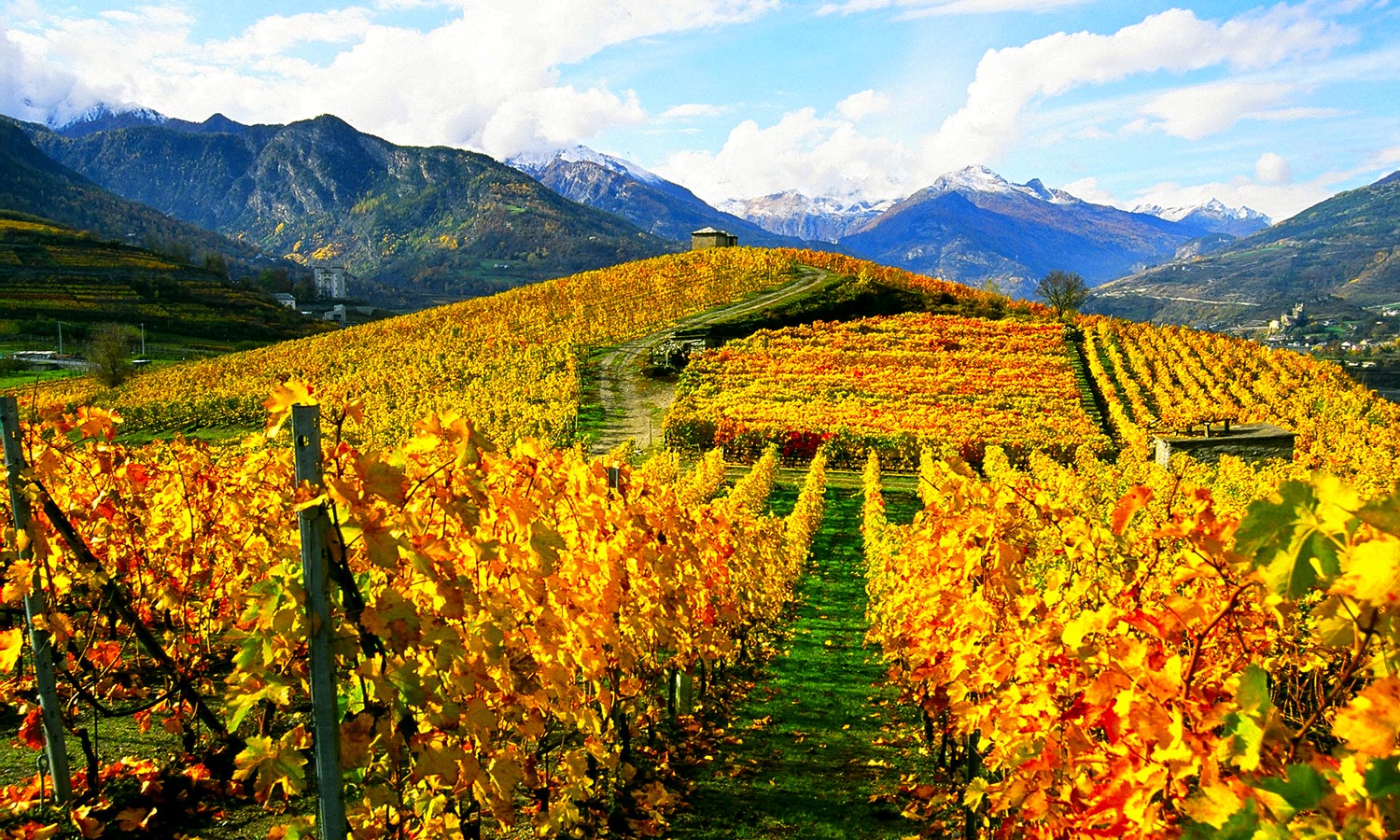
In the shadow of the Alps and sparsely populated, Valle d’Aosta has been described as Italy’s forgotten corner. French and Swiss cultural influences reinforce the perception among outsiders that it is even less Italian than Alto Adige, a seldom traveled outpost that attracts intrepid hikers, skiers, and culinary adventurers seeking a plate of ibex prosciutto.

There is little wine tourism, no well-marked strada del vino per se. The region ranks last in vineyard acres and volume produced, about 165,000 cases a year. There are single estates in Tuscany and Sicily that surpass that number. Nor is there much external demand for that small amount of wine that does cross provincial borders. Valle d’Aosta wine is not an oxymoron, but the words fail to register for most wine drinkers.

It is a place where vineyards cling tenaciously to terraced hillsides at altitudes ranging from 900-3900 feet. Conditions tax not only grapes but the determination and skill of winemakers coaxing Chardonnay, Nebbiolo and obscure local varietals from glacial soils. Every phase of viticulture requires intense manual labor. To avoid wind damage and absorb heat retained by the ancient stone walls that surround them, many vines are planted close to the ground in the pergola bassa manner.

Though 90% of Valdostana wine is red, it was a white singled out for high praise by the late Luigi Veronelli, regarded as a pioneering figure in Italian gastronomy and viniculture. Asked if only one grape could be saved from extinction, he surprisingly selected Blanc de Morgex (also called Prie Blanc; those unfamiliar are not in the minority). I posed the same question to a widely respected Tuscan winemaker, who averred that arriving at one answer was simply impossible. When I informed her of Veronelli’s choice, it elicited both a quizzical shrug as well as the admission that she had no knowledge of it.

Originally known as Prie, it is the oldest grape of record in Valle d’Aosta, and all of the sixty or so acres dedicated to it are DOC designated. It is the only grape able to withstand the cold air that descends on the communes of Morgex and LaSalle in early autumn, which explains its alternative labeling. And while I’m not inclined to second Veronelli’s testimonial, or even include it on a personal Mt. Rushmore of grapes, the two Prie wines I’ve come across are both distinctive and pure expressions of the Morgex-La Salle sub-zone.

The crystalline, almost watery color of Cave du Vin Blanc Vini Estremi is an indication of the aromatic lightness of pear, pineapple and spicy minerals. A blast of gum-chilling lemony acidity is as refreshing as diving into a mountain lake, and cleanses the palate for sharply defined flavors of mint, pear and apple. There’s also an unexpected, kinky hint of pine nuts. This dose of high altitude clarity and energy is like nothing I’ve encountered.

Ermes Pavese Blanc de Morgex et La Salle, on the other hand, offers slightly more color, a pale yellow. The nose exudes a mild earthiness, with a brief but curious vegetal scent mingling with flowers. Crisp white stone fruit becomes livelier from waves of mouth watering acidity that holds a bite of white pepper. Though not as direct or refreshing as the Cave du Vin Blanc, it still represents Prie from the Alta Valle with aplomb.

les-cretes3

Prie isn’t the only Valdostana white wine worth discovering. Petit Arvine has been grown since 1600 in the Valais of Switzerland and has fared well in the unfiltered sunlight of Aosta, at lower elevations than Prie. Discovering a bottle at a trattoria in Sorrento, on a long-ago trip to a far-more-southern locale, was an incongruous bit of good luck. I’d heard of the grape, but this was my first chance to try one, in this case from Constantino Charrere’s Les Cretes, one of the few commercial producers that can be found in America. This wine offers intense aromas and flavors of flowers, melons, pineapple and mandarin, yet there’s a mild surge of salinity toward the end for balance. I’d describe it as zesty, light and flinty, with a little more body than Prie yet without the eye-popping acidity.

Fast forward a decade to my next encounter with Petit Arvine, this time a 2011 from La Crotta di Vegneron. It could not be more different then the Les Cretes, possibly because it came from lower lying vineyards near Chambave. Despite the expected charge of acidity, this version is warm and inviting, with a texture that’s tart at first but evolves into a lush, mouth-coating blend of exotic melons, apricot, citrus and herbs. A balancing and cleansing dose of minerals perks up the long aftertaste.

A review of Valle d’Aosta wine without mention of the legendary Ezio Voyat of Chambave would be a disservice. I was lucky enough to taste Voyat’s final vintage of “La Gazella” — named for his daughter, an Olympic track star — in 2003, just before he died. Unlike Chambave Muscat Fletri, the region’s version of passito, Voyet vinifies this 100% Moscato Bianco vino di tavola bone dry. Featuring the same crisp acidity of the other whites, it’s also somehow fuller and more round. This results in a cider-like sensation that suggests apples dipped in a mineral bath.

Unusual, yes, but not unexpected in Italy’s northwest frontier.

Images via Les Cretes

Sicily Redux

Castellucci Miano
Castellucci Miano

There was a moment after returning from our autumn journey when I found myself empathizing with Michael Corleone. Just when it seemed I’d had enough of Sicilian wine, they pulled me back in, courtesy of a Castellucci Miano tasting at Center City’s Vintage Wine Bar. Piero Buffa, the estate’s representative, was on hand to add insights and discuss drumming up interest in Sicilian wine in America. For those of us in the commonwealth, the wines are available in the system.

Castellucci Miano Catarratto 2012 ($19.99)
This grape accounts for about 10% of land under vine in Sicily. In fact, it is second only to Sangiovese in volume of acres planted. Light, savory, crisp – sounds like most Italian whites. “Miano” is exceptionally clean on the nose and in the mouth, with precisely etched aromas and flavors of apple, lemon, pear, pineapple and wild herbs. The moderately long, fruity finish stays balanced and refreshing.

Castellucci Miano Nero d’Avola 2009 ($17.39)
There’s a lot of fruit up front, but not in an opulent or showy way. Dark cherries, raspberry and plum are concentrated without being jammy or inducing a feeling of downing liquid compote. If you want to typecast this Nero it’s on the fuller, modern side compared to those from southeastern Sicily. This doesn’t make it unappealing, in fact, this version seems less dense and “damn the acidity, full fruit ahead” than many over the top Neros I’m trying to forget. (SLO, minimum order of six)

Castellucci Miano Perricone 2009 ($32.89)
An honest and unpolished example of yet another Italian varietal that you hear little mention of on the grapevine. It has some familiar Cab-like qualities – dry green spices, a rough herbal tang, even a brief hit of graphite – to go along with earthy dark cherries and currants. Perricone, even one as well made as this, isn’t an easy wine to grasp, so the price tag may scare some off. The adventurous and/or geeky will find something to mull over (SLO, minimum order of six)

WHITES

Anyone who has visited wine regions abroad knows the frustration of tracking down those bottles that dazzled you once you’re home. Aside from those I reviewed from my Sicilian winery visits, there were several others we enjoyed that a CIA operative would have difficulty locating. Fortunately, there are Sicilian wines that you may not find at your closest state store but which are not out of reach. Or you could just book a trip to Palermo.

First, a quartet of whites that highlight indigenous grapes.

occhipinti-sp68-biancoArianna Occhipinti SP 68 Bianco 2013 ($24.98)
While I agree with Mike that some of her red wines have not lived up to their hype, SP 68 is an intriguing mix of Albanello and Zibbibo (the Arabic for Moscato of Alexandria). It has some vague references of aroma and overall sensations to Riesling and Viognier, with a dash of Gewurzy spiciness. A tropically floral nose of melons, coriander, citrus and exotic herbs leads to smooth-edged flavors of peach and pear energized by brisk acidity. This is Sicily at its best, delivering the unexpected. Available at Wine Works, Marlton, NJ

COS Rami 2012 ($29.99)
If you are up for a challenge, this blend of equal parts Inzolia and Grecanico is eccentric in a good way. It doesn’t look like an orange wine but has the same depth of aroma, intensity of flavor, firm texture, and fullness in the mouth that comes from extended maceration. Salinity, minerals and a strange nutty element provide a vibrant lift to ripe lemons and oranges that offset an unusually moderate level of acidity for a Sicilian white. This wine is a mouthful of non sequiturs. Purchased at Wine Library, Springfield, NJ.

Firriato Le Sabbie del Etna Etna Bianco 2012 ($14.98)
Carricante is fast becoming my grape of choice to pair with most Sicilian seafood dishes. This one includes 40% Catarratto, whose fullness takes some of the nervous energy from its partner. The trade-off is increased ripeness and lushly concentrated flavors of lime, citrus, pear and peach that wrap themselves around a mildly nutty finish. Available at Wine Works.

Tasca d’Almerita Buonora 2012 ($16.98)
Here we have Carricante on its own, all flowers, citrus, native herbs – an interesting contrast to Firriato. The peaches and tropical melons may be just as ripe, but the lively and persistent acidity and savory minerality keep it refreshing and focused from first to last sip. It’s more straightforward than complex, and that approach places it a cut above others I’ve had. Available at Wine Works

ETNA REDS

Nero d’Avola may be Sicily’s favorite son, but red wines from Mt. Etna are earning a deserved place at the table. To paraphrase Johann Goethe, “To drink in Sicily without drinking Nerello Mascalese is not to have drank at all.” Hard to argue with that.

Alberto Graci Etna Rosso 2012 ($25.99)
There’s a reason why Graci has been getting high praise for his wines. His Nerello may have a Burgundian feel – high acidity, finely calibrated tannins, and a core of earthiness that adds to underlying complexity – but it also offers that spicy cherry and smoky essence on a crisp, effervescent entrance, which is pure Etna. Graci has achieved an admirable balance of muted rustic power and finesse. This is a lot of wine for the price. SLO, minimum six. Also available at Wine Library for $17.99.

Pietro Caciorgna Thalia Etna Rosso ($22.99)
Though a modern take on Etna, complete with sweet vanillin from barreling, there’s no mistaking the smokiness and grainy minerals of volcanic soil. Young and still evolving, it’s somewhat closed and restrained, with sharp edges that are blunted by gentle tannins. There’s something buried here that begs for cellaring another year or two. Purchased at Garnet Wines, NYC

Calabretta Cala Cala NV ($16.99)
Want to turn heads and palates at the next dinner party? This is what to bring, a Nerello with attitude to spare that doesn’t need rhapsodizing or nattering on about its details. Enjoy it for what it is, a natural expression of Etna, a rugged blast of macchia – wild flora, volcanic minerals, and a smattering of aromatic green herbs – that lingers on the warm, satisfying finish. Purchased at Flatiron Wines, NYC