One of the distinct appeals of wine geekery is its ability to branch out to other disciplines. We’re not limited to what’s in the glass – this can also be about history, geography, travel, people, culture. So much can be gleaned about the world, all from a single bottle, all without leaving the table. It’s magical stuff.
This magic, of course, can’t be found in just any bottle on any shelf. It won’t be found in Pink Moscato, that’s for sure. It might not even be found in Chianti or Medoc. Not that Tuscany and Bordeaux aren’t charming – that goes without saying – but these regions are also well-trod, especially by wine lovers. Finding the road less traveled, on the other hand, sends a tingle of excitement up the spine, and, if we’re being honest, can stimulate the taste buds unlike the tried and true.
What we have here, then, with the Conti Sertoli Salis Valtellina Superiore
Grumello 2009, a “Chairman’s Selection” in Pennsylvania, offered at the tantalizing price of $12.99, is that coveted opportunity to stimulate both the buds and the brain. Let’s go exploring, shall we?
Often overshadowed by capital city Milan, the Lombardy region lies in North-Central Italy, between Piedmont to the west and Veneto to the east. It is not known, at least worldwide, for winemaking. But that doesn’t mean it lacks tradition or quality – in fact, production dates back to early Greek settlements on the Po River. And more recently, Franciacorta has become perhaps Italy’s finest producer of sparkling wine.
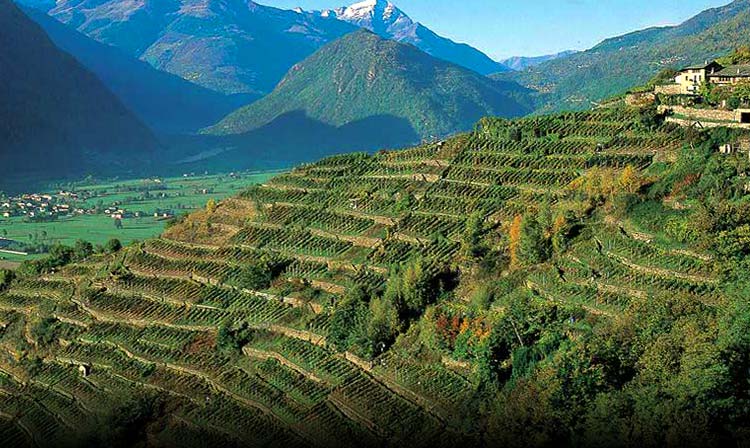
At the region’s northernmost tip, abutting the Swiss border, lies remote Valtellina. This type of wine country is, for me, the most fascinating to investigate. Like Alto Adige or Valle D’Aosta, the natural perch of these hamlets, the way they’re carved into treacherously steep mountainsides, separated not only from the rest of Italy, but the entire world, by nature itself, makes them stand out. Though culture is influenced by both Italians to the South, and, in this case, Switzerland’s Germanic heritage to the North, their innate isolation imparts its very own rugged identity to people, place, and, of course, wine.
There is no mechanical farming here; the steep, rocky slopes, ensure that. It’s said their sight alone is enough to make one’s knees buckle, and dangerous landslides are not out of the question. Though it is a sub-alpine climate – St. Moritz is closer than Milan, meaning wines with low concentration and bristling acidity are the norm – there’s also intense sunlight, so much so that agave and prickly pear have been known to mingle among vines.
The main red grape here is Nebbiolo. That’s right, the very same noble variety of the Piedmont, of King Barolo and Queen Barbaresco. How it came to be in these far reaches is unclear, but it thrives just the same, albeit differently. The dried roses, tar and cherry fruit, tannin and acidity are all still there, but it’s a more feminine, nervous package.
For Valtellina Superiore, the DOCG, of which this wine is, 90% Nebbiolo, referred to locally as Chiavennasca, is required (versus 80% in the DOC), with the rest either other local grapes such as Rossola and Brugnola or internationals like Merlot and Pinot Nero (Noir). Within Superiore, the finest wines are thought to come from four identified vineyards, sometimes referred to, unofficially, as the Grand Crus of Valtellina: Grumello (from where this wine hails), Sassella, Inferno and Valgella. Grumello’s vineyards are the least steep of the four, with more actual soil, so these wines tend to deliver the most approachable, fruit-forward flavor.
 This particular Grumello is reticent at first, tight on the nose, the type of wine that absent-minded sippers will discount without a second thought as uninteresting. Patient, careful observers, however, will be rewarded with complexity and beauty. It starts out fruity, showing red apples (almost Riesling-like for a moment!), plums, sweet & sour cherry and orange peel. With air, it becomes more savory, with tobacco, Asian spice, dust & dirt, smoke, earth and mushrooms. In other words, there’s quite a bit going on here.
This could work well as a warm-weather red for immediate drinking (as with most Nebbiolo, give it some air). Though the sneaky tannins shouldn’t be overlooked, they’ll actually play nicely against grilled meats, while the bright, tangy fruit will keep things lively without bogging down the palate. That said, this’ll also lay down for another 3-5 years. Either way, food is a requirement for maximum enjoyment.
For Barolo and Barbaresco lovers who haven’t tried this version of the fog-friendly grape, this is an absolute must. Let’s be clear though – it’s not going to stand up to the greats of Piedmont. It’s merely another face of Nebbiolo that should be experienced, especially at this price.
For those yet to encounter the enigma that is Nebbiolo, perhaps price or cellar time has been a barrier. Now’s your chance. Should it be the wine you judge all varietal wines by? Absolutely not. It does, however, give a glimpse into what the grape has to offer – an elegance which belies hidden power and depth.
Happy travels.
#ItalianFWT
This post was featured in the #ItalianFWT group’s February 2017 topic: Nebbiolo Beyond the Bs. Here are links to the other featured posts:



 #ItalianFWT
 There was a time in the recent past when it was unimaginable that Italian wines such as Perricone, Verduzzo and Petit Arvine would one day be found in the PLCB system. (We’re all familiar with the Chiantis, Pinot Grigios and others that commandeered the shelves.) Supply was reacting to a demand for recognizable wines that reflected and satisfied casual drinkers’ understanding of what Italy had to offer. As consumers have become more knowledgeable and willing to expand their comfort zone, interest in heretofore obscure and exotic varietals has undergone a commensurate growth.