Warning: Undefined variable $url in /home/undiscov/public_html/undiscovereditaly/wp-content/plugins/twitter-facebook-google-plusone-share/tf_display.php on line 365
#VirtualSagra‘s recent spotlight on the eternal Spaghetti all’Amatriciana got me thinking about the holy trinity of Roman dishes: Amatrice’s famous contribution of course, alongside Carbonara and Cacio e Pepe. All quintessentially Roman with their balance of simplicity and flavor, classic recipes that naturally attract a certain amount of fervor and devotion. (And don’t even get me started about the additions!)
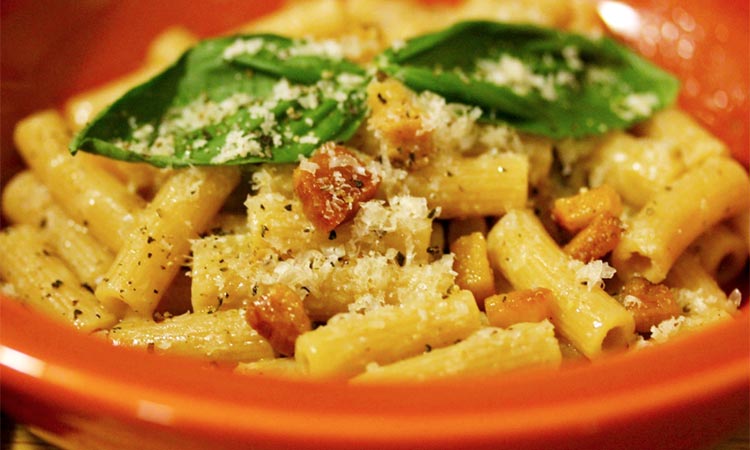
On my last visit to Rome, however, I tried another typical Roman pasta for the first time: Rigatoni alla Gricia. A dish that some — quite sensibly, in fact — refer to as the foundation for both Carbonara and Amatriciana. Others call it Amatricianain Bianca. Me, I see it more as a cross between Carbonara and Cacio e Pepe. Either way, it simple and comforting yet rich, intense flavor fits the mold quite well.
Gricia is, essentially, Cacio e Pepe with guanciale. Carbonara without egg. Or Amatriciana without tomato. (I’ve fallen into the same trap!) In actuality, the latter is probably the most accurate, since many believe it was the precursor to the red sauce, before tomatoes were abundant available in the region. The name is also thought to come from Grisciano, a town just north of Amatrice.
Gricia involves only a few ingredients. Pork (preferably guanciale, though pancetta is a reasonable substitute), Pecorino cheese, black pepper and pasta. That’s all. So simple, yet so luscious. As the Romans do best.
Another famously Roman aspect of this dish is controversy over its ingredients. Onions? White Wine? Italians take these seemingly minor ingredient suggestions as sacrosanct. Last year, when celebrity chef Carlo Cracco suggested adding onions to the dish on MasterChef Italia, it became headline material across the country. (It didn’t help that he’d, horrifyingly, suggested adding garlic to Amatriciana just days before.)
If we put those blasphemous additions aside for the moment, the technique is quite simple:
Cook pasta
Brown the guanciale over medium heat. (If you like you can add some EVOO or lard to get the process going, though it isn’t entirely necessary.)
Add black pepper to pan.
Add a ladel of pasta water to the pork.
Mix in some grated hard Pecorino (I prefer an aged version other than Romano, which can be too salty.)
Add pasta and cheese and mix. Use more pasta water if it sticks.
Serve with more cheese on top.
As with our findings related to pairing wine with Carbonara, looks can be deceiving here. Just because it’s light in color doesn’t mean it’ll match to white wine. The fatty pork and the aged cheese suggest — nay, demand — a hearty red. Any quality Central Italian should do the trick; in our case, an IGT rosso from Montefalco matched quite well.
I discovered the majesty of spaghetti alla carbonara much later than I should have, sadly, because I was under the impression, for many years, that it should include cream. Romans, I eventually and thankfully learned, would never dream of adding cream to an already rich, hearty dish such as this. (Come to think of it, why on earth would anyone?)
Finding the real carbonara, then, sans cream, peas, and any other junk Americans have tried to adulterate it with over the years, reminded me of how amazingly complex and delicious simple, well-prepared food can be. Not including the water, salt & pepper, it only requires four ingredients: pasta, eggs, cheese and pork. Individually, humble, but together, grand. A peasant dish, for sure, but as a whole, something far greater than its parts. Something that can deliver one of the truly sublime bites of one’s lifetime.
I still remember my first taste of transcendent carbonara. It was in a tiny apartment in Rome, an appropriately meager, yet timeless setting. I’ll never forget how the dish came together perfectly, how the first bite coated my tongue. The rich, luscious sauce. The silky fat. The salty, crunchy pork. The punchy peppercorn. How each element contributed to something above itself, how the moment froze, an enduring taste in the eternal city.
I’m a guanciale man when it comes to Roman pasta. That’s cured pork jowl, for the unfamiliar, which is arguably the most traditional choice used in both this and pasta all’Amatriciana (pancetta can also be used). Although bacon is easier to find, neither of these Italian salumi is smoked, so there’s a different flavor profile. Guanciale is also much fattier, giving it a richer, deeper essence. And even if one might learn to prefer a smoky flavor with their eggs in carbonara, for me there’s something to be said for knowing where a dish comes from before messing with it.
(If you’re interested in how I make carbonara, view my recipe here. Otherwise read on.)
Wine Pairings
When it comes to pairing wine with Carbonara, there’s rarely consensus. On one hand, an egg-based sauce might suggest aromatic and white. On the other, pork fat. It’s tricky for sure. Before writing this, I did a lot of online research and found suggestions all over the spectrum (even more so than usual), people enthusiastically and determinedly recommending everything from Prosecco to northern Italian whites, southern Italian reds and everything in between. One person even suggested a well-aged Barolo.
So I took to Twitter, asking some of our food & wine expert friends to see what they’d have to say on the matter. As expected, the disagreement persisted.
Catherine Fanelli (@CatFanelli), sommelier at the Moorestown, New Jersey outpost of Mark Vetri’s Osteria, initially suggested an elegant Pinot Grigio to match the creamy sauce. Moore Brothers’ Susan Crawshaw (@susancrawshaw) also leaned white, nodding towards the regionally appropriate Frascati, before admitting to having recently enjoyed a Chiaretto – a Rosato from Northeast Italy – with the dish. (And perhaps Rose is the great equalizer here – especially one with some tannic bite – that’ll bridge the gap between the eggs and salty, rich meat.)
On the red team, Caroline Matys (@Caroomat), sommelier at Pittsburgh’s Legume Bistro, made the savvy recommendation of a Chianti Classico from the area of Greve, specifically noting that the Greve soil produces elegant reds that won’t overpower the dish. Fanelli echoed this sentiment, suggesting that an appropriate red would be light-to-medium bodied with high acid.
Joe Cicala (@Joe_Cicala), chef at Philadelphia’s Le Virtu, on the other hand, pointed out that the dish is particularly high in fat, and thus could benefit from a wine that is high in tannin. In particular, he called out Cesanese del Piglio, an indigenous red to Lazio (Rome’s region), bringing up the famous phrase “if it grows together, it goes together”.
This would be a good time to mention, however, that carbonara’s history is quite the mystery. Where did it come from? Is it really Roman? Nobody knows for sure. One urban legend suggests it is a relatively new dish, a product of American GIs bringing eggs and bacon to the area during World War II – though this story is generally dismissed by most food historians. I won’t go into all the other theories here (there are plenty online), but there are those that suggest carbonara might actually hail from Abruzzo or Campania. Wherever its true origins lie, if it isn’t Roman, can we even invoke grows together/goes together? It certainly becomes a trickier sell than say, pici & wild boar with something Tuscan.
Not to mention that we haven’t definitively answered the red / white question. Personally I’ve always been a red man, perhaps because on that aforementioned Roman evening, we drank cheap Montepulciano d’Abruzzo, ubiquitous punch that neither inspired nor marred the dish; in many ways its peasant ways an appropriate mate (which would jive with the Abruzzo myths). In the days since, I’ve leaned on medium-bodied, high-acid reds like Sangiovese and Barbera, food-friendly bedfellows that never do poorly when coupled with pork or aged pecorino (and let’s not forget how much cheese there actually is in this sauce.) But I don’t think I’ve ever tried it with a white.
Well, for you, dear readers, I, dedicated scribe, have decided to sacrifice myself. If someone must eat carbonara and drink wine, I suppose I will take the proverbial bullet. To procure guanciale and super-fresh farm eggs, I emailed my friends over at Wyebrook Farm in Chester County, PA. They are a sustainable, 100% grassfed farm that raises all their own pigs, chickens and cows, and cures their own salumi on site. (If I must force myself through this draconian trial, only the best will do.) If you have the means, I highly suggest checking them out.
I pulled out La Scolca Gavi Oro 2013, a crisp, aromatic white from the Piedmont, which seemed to fit the bill and also happened to have recently come out on Chairman’s Selection at the time of this writing. I also had a bottle of Corte dei Papi Cesanese del Piglio Colle Ticchio 2011 that I picked up during this summer’s PLCB wine club closeout sale that I was especially interested in trying with carbonara due to the aforementioned grows together/goes together discussion.
The Gavi was lovely, floral on the nose, heavily perfumed, with fruity notes of apricot and peach on the palate, and plenty of acidity on the finish, but was not at all a match for the dish. Though the concept of a crisp white to clean away heavy, rich flavors certainly makes sense – similar to how an off-dry Riesling goes so well with spicy Asian fare – this style of white wine simply does not have the stuffing to stand up to carbonara. The Gavi, of course, was just one wine, but it is clear that any white attempting to take on this challenge would require much more power – maybe a big-bodied wine from Southern Italy – or some other factor like sweetness or bubbles.
The red, however, was an excellent match. Smoky, earthy qualities played nicely off the guanciale and cheese and the tannins stood up to the fat. This particular Cesanese was loaded with bretty barnyard on the nose – as stinky a wine as I’ve ever tasted, which I loved, but is certainly not for everyone – that added to the rustic charm. With a good dose of air, the aroma resolved to more of a scorched earth vibe, and a sweet cherry note took over the palate. If anything, the rich fruits and assertive tannins may have been slightly heavy, but it was still a solid pairing.
My exploration, of course, is limited by my own willpower and GI tract capabilities, but I assure you it will continue… just as soon as I recover from the last one.
What do you pair with carbonara? What has worked, and what hasn’t?


 The Gavi was lovely, floral on the nose, heavily perfumed, with fruity notes of apricot and peach on the palate, and plenty of acidity on the finish, but was not at all a match for the dish. Though the concept of a crisp white to clean away heavy, rich flavors certainly makes sense – similar to how an off-dry Riesling goes so well with spicy Asian fare – this style of white wine simply does not have the stuffing to stand up to carbonara. The Gavi, of course, was just one wine, but it is clear that any white attempting to take on this challenge would require much more power – maybe a big-bodied wine from Southern Italy – or some other factor like sweetness or bubbles.