Warning: Undefined variable $url in /home/undiscov/public_html/undiscovereditaly/wp-content/plugins/twitter-facebook-google-plusone-share/tf_display.php on line 365

Gray Matters

castelfeder-pinot-grigio-vineyard

Pinot Grigio. One of the most well-known Italian grapes, it just might be the least respected among connoisseurs. This typically cheap white is, of course, inarguably one of the best-selling in the US, but rarely receives oenophile attention.

“It doesn’t really taste like anything,” says the wine specialist at my local store when I bring it up. This opinion is not a solitary one; it stems from the tide of bulk wine that flows out of the “delle Venezie” IGT (mostly Veneto and Trentino), made by wineries like Cavit, Bolla, and Mezzacorona. Pale and insipid, this juice can offer some freshness but not much else.

On the Esquire show Uncorked – which follows several Master Somm candidates as they prepare for their exam – one guy is shown rinsing with Grigio in place of brushing his teeth the morning of a blind tasting, so as not to throw off his palate.

At my local wine school, instructors suggest using Pinot Grigio to rinse the glass when transitioning to a new wine, as it will neither dilute the next pour like water nor affect the flavor like another wine. (The best rinse is actually the 2nd wine, but that’s another conversation.)

“Pinot Grigio is perceived by the market as a watery, super-light wine,”  Max di Lenardo of Friuli-Venezia Giulia’s Di Lenardo Vineyards confirms. “The grape has been successful, so now there are a lot of industrial wines that don’t taste like the real thing. In our region,” he continues, “we don’t have big cooperatives like this. We are a small area and almost all of our Pinot Grigio is family-owned, estate-bottled wine.”

Interestingly, Pinot Gris – the same grape, with French styling – receives none of the disrespect of its Italian twin. It’s quite highly regarded, in both Alsace and in Oregon. People rarely call it boring or plain; it can feature in some of the most exciting whites from those regions.

Despite carrying a healthy dose of skepticism for years, I recently find myself wondering if Grigio can ever match up to Gris. Is Italy’s version a lost cause, or can it actually be good?

My awakening begins with a bottle from Castelfeder in the Alto Adige that’s full-bodied and luscious, turning any and all previous notions of the Grige on their head. Of course, most of my experience up to this point has been of the Santa Margherita mold: well-known but not particularly good.

I start to seek wines made in the ramato-style – a copper-hued wine that’s been fermented briefly on its skins, imparting some of the color, flavor and tannin. Produced primarily in the Friuli-Venezia Giulia sub-region of Collio, they’re not only surprising in appearance but offer a completely different gustatory experience when compared to the stuff we all know and, er, don’t love.

Di Lenardo, who produces the ramato Gossip, says he enjoys vinifying a wine in this “special” way that the industrial cellars won’t, as well as helping to educate consumers that the Pinot Grigio grape is actually quite dark in color (Grigio means gray).

pinot grigio grapes

He also notes how this method can produce “bigger texture” as well as “distinctive aromatic power.” And while Gossip does feature varietally typical flavors of stone fruit and tart apple, there is absolutely more. Feral notes of hay and fuzzy peach showcase in the aroma, and a distinct bitter almond note coincides with the finish. Though softer than I’ve come to expect with Grigio, a nibble of tannin adds balance.

One of the finest ramato bottles I come across takes me out of Italy, across the border to Slovenia, specifically the region of Štajerska, which – although towards the eastern side of the country — is still as close to Collio as Verona. The winery Pullus (aka Ptujska Klet) has been around for a little bit, according to the label, which claims, no joke, “since 1239.” Regardless, they produce a killer ramato, lighter than Gossip but also sharper, redolent of strawberries and raspberries followed by a mineral and herb-tinged finish. With no disrespect meant to the surely wonderful folks of Štajerska, this is one fine Italian Pinot Grigio.

Though distinct, the ramato-style in and of itself neither equates to bigger or more serious. Take the wines of Fruili’s Attems. While their ramato offers up rose-like fruit alongside a touch of tannic dryness, the overall impression is gentle and elegant. Attems’ non-ramato Pinot Grigio – which is darker than plonk yet still a white wine – on the other hand, is rich and lush, showcasing deep fruitiness (tangerines!) alongside nutty complexity and mouthwatering salinity. Wow.

attems pinot grigio
Image via Attems FB page

Heading back up to the Alto Adige, Peter Zemmer Pinot Grigio is yet another standout. Perhaps the palest of the mentioned wines, it defies that with bold flavor. Huge herbal aromas act as an Alto Adige calling card, but opulent peach, pear and melon bring balance. Experiencing this abundant fruit’s coexistence with vibrant freshness, it’s hard to imagine this grape ever developing its reputation for blandness.

So why does it? Judith Unterholzner – who represents Alto Adige wineries Terlano and Andriano – suggests this phenomenon is mainly due to exaggerated yields. “Whenever producers fail to reduce quantities harvested per hectare to get higher quality primary fruit, Pinot Grigio cannot demonstrate its full potential,” she notes. “We cultivate our Pinot Grigio with the same production philosophy like all the other wine; by taking care of the vines. This creates a product of remarkable quality, balancing varietal typicity with the Alpine brightness our region is famous for.”

It also, of course, requires higher costs. “Low yields are the main reason for the high quality,” Unterholzer continues “which clearly has to have a certain price, since we invest on average 500 hours of manual work per hectare to get the best out of the vineyards.” Don’t fret, though. It’s still only about $20/bottle. Tough to compare on paper with Cavit at $8, perhaps… until the wines are tasted.

This story is, in the end, hardly surprising. Should we, for example, estimate the potential of California Cabernet by bottles of Woodbridge and Barefoot? Hardly. Nor should we judge Pinot Grigio based on bulk garbage.

Me, I began this quest intrigued yet skeptical about the potential of Pinot Grigio. Now here I sit, an unabashed fan. Are you finally ready to open your own mind?

Recommended Bottles:

  • Pullus Pinot Grigio
  • Di Lenardo Gossip Pinot Grigio Ramato
  • Attems Pinot Grigio & Pinot Grigio Ramato
  • Peter Zemmer Pinot Grigio
  • Castelfeder Pinot Grigio
  • Donna Alma Pinot Grigio Dolomiti

Top image via Castelfeder Facebook page.

#ItalianFWT
This post was featured in the July 2016 Italian Food, Wine & Travel group’s Twitter chat on orange wines. Check out a list of other posts from the group:

Forza Friuli!

perusini-ribolla-gialla
image via Perusini Facebook page

In no other region of Italy, with the possible exception of Alto-Adige, can be found, across the board, white wines of the quality and complexity as those produced in Friuli. Operating in the cultural crossroads that are a constant reminder of Italy’s past, Friuli’s winemakers were among the first to combine generations of farming wisdom with the innovative technologies and practices of the 1970s, establishing a template for producers throughout the peninsula. Whether their wines came from international favorites such as Sauvignon Blanc and Chardonnay or indigenous vines of Friulano, Verduzzo, Picolit, or Ribolla Gialla, there was a common thread evolving – crisp and vivacious, pure expressions of each grape’s true characteristics.

The good news for consumers is the number and variety of Friulian wine showing up stateside, as more Italian producers are forced by necessity to increase their export share to offset a dramatic decline in domestic consumption over the last five years or so. It’s not uncommon to come across bottles from Friuli in wine stores or on restaurant lists, such as the two we’re focusing on.

The tale of Ribolla Gialla is similar to that of many of Italy’s “native’ grapes, related to or DNA descendants from somewhere else, in Ribolla’s case, Robola from Cephalonia in Greece. References to it date from the 13th century, when Friuli was part of the Venetian Republic, the pre-eminent Mediterranean traders of that era. In its adopted homeland the grape thrived in the well ventilated Colli Orientali, the eastern hills on the Slovenian border where cool northern air currents interact with the warmth of the Adriatic to foster conditions in which grapes ripen slowly and achieve a more natural balance.

The Perusini estate in Gramogliano is modest compared to its neighbors but is credited with reviving Picolit, the region’s passito style wine. It is Ribolla, however, that is their premier offering. Teresa Perusini has likened their unoaked Perusini Ronchi Gramogliano Ribolla Gialla Colli Orientali del Friuli 2011 ($21.99) to Audrey Hepburn, noting its lean profile and reticence. I don’t know about that, but it is neither bold nor flashy, and does take a while to reveal its inherent nature. It’s a white with an obvious but downplayed structure that supports a surprisingly rich and fleshy body (Sophia Loren, maybe?).

dilenardo-tohThere’s a slender strain of acidity and minerals that keep it lively and on point. From a muted, slowly evolving nose of pears and just a whiff of mint to the pleasantly savory finish you find a persistent saline sensation – fairly common for Friuli. My thought is that a second bottle might allow for the discovery of even more nuances and complexity. Perusini’s version would go well with mildly flavored vegetables or fish, but for me it would be a simple plate of lardo and prosciutto di San Daniele.

Di Lenardo Toh! Friulano 2013 ($10.98 @ WineWorks, Marlton, NJ) plays on the fact that it was formerly known as Tocai Friulano. Even though it’s a dry wine, and is not the grape in Hungarian Tokaj, the confusion was sufficient to persuade the European Union to order Friuli’s winemakers to drop any reference to Tocai. The region’s signature white grape is most closely linked Sauvignonasse, a French cultivar and the name by which it is most widely known outside Italy.

Di Lenardo’s state-of-the-art cellar is in the Grave DOC close to Veneto. In contrast to Perusini, the estate churns out 650,000 bottles a year, 70% of which is exported. “Toh!” stays on its lees until bottled, accounting for the creamy texture and ripeness of flavor. The fact that it never sees wood brings out precisely defined aromas and sensations. Saltiness blends with citrus and almonds on the nose, along with a thinly disguised vegetal quality that has the sharpness of Sauvignon Blanc. It loses nothing from start to finish, the package holds together throughout. This is a white wine that is drinkable year round, as comfortable with bean based soups or roasted white meats as it would be with prosciutto and melon.

Wine… Women… Hold the Song

Giovanna Tiezzi of Pacina Winery
Giovanna Tiezzi of Pacina Winery (img via Facebook)

The recently celebrated International Women’s Day took on a decidedly Italian accent with “La Festa Della Donna” at Osteria in Philadelphia, a dinner honoring four of Italy’s female winemakers. From Elisabetta Foradori in Trentino to Sicily’s Arianna Occhipinti, the emergence of women taking a leading role in viticulture is noteworthy in a country long thought of as a bastion of Old World tradition. In some cases, the patrimony of legendary estates such as Bartolo Mascarello, Bruno Giacosa, and Gianfranco Soldera has passed to and been stewarded by their daughters. In others, like Elisa Semino of Piedmont’s La Colombera, women work alongside fathers and/or brothers.

A common philosophy and approach to winemaking brought together the terroir-breaking representatives at the dinner. Each is committed to organic and biodynamic practices; minimal, non-intrusive techniques in the cellar; and limited production of artisanal wines, less than 4000 cases per year, relative drops in the international wine ocean. As they spoke to the assembled guests, there was an evident yet understated pride in their craft, tempered by a humility that acknowledged their reliance on and reverence for the soil in which they work.

The wines selected for the evening are distributed by The Artisan’s Cellar, a West Chester based facility, and can be ordered through the PLCB’s special order procedures.

Silvana Forte, Le Due Terre

In the eastern hills of Friuli, hard by the Slovenian border, Silvana and husband Flavio Basilicata make wine from indigenous and international grapes. No technology intervenes in their traditional methods, such as the use of natural, native yeasts to promote spontaneous fermentation.

Sacrisassi Bianco 2010, Colli Orientali DOC (PA SLO #528132, $49.19) A blend of local varietals, 70% Friulano (formerly known as Tocai Friulano) and 30% Ribolla Gialla. Unlike many white wines, this stays with you from the intense, focused aromatics of ripe orchard fruits to its lingering aftertaste. Vigorous minerals, the typical salinity found in this area’s wines, and crisp acidity keep the medium body fresh and lively. (89-91)

Valeria Gurrieri, Vini La Favola

The husband and wife team of Valeria and Corrado preside over vineyards on Sicily’s southern coast near the town of Noto. They and the land he inherited are one, and every aspect of their winemaking, from vine to bottle, reflects a synergy absent in mass-produced wine.

Fravolato 2010, Sicilia IGT  (#527399, $21.29)  Spicy, lively, persistent, flavorful, zesty – just a few of the adjectives that describe a wine fermented in steel by select native yeasts. There’s an undeniable Sicilian earthiness at the core of red berry and cherry flavors from Nero d’Avola, and the 40% Frappato brings a refreshing acidity that tones down some of its partner’s rustic edge. For those who still hold to the idea that red wine doesn’t pair with fish, this was creatively served with pistachio crusted tuna and couscous, a nod to the Arabic influences in Sicilian cuisine.  (90-92)

Giovanna Tiezzi, Pacina

Pacina has been described as the “Godfather” of the organic farming movement in Tuscany. Situated in Castelnuovo Berardenga, on the meandering border of Chianti Classico and the Colli Senesi, Giovanna Tiezzi and husband Stefano Borsa produce wine that is not manipulated through technology, resulting in pure expressions of Sangiovese and other grapes.

La Malena 2007, Toscana IGT  (#514321, $38.59)  A 100% Syrah vinified in concrete tanks, then transferred without filtering to age in large oak casks – and it shows. The mildly leathery, herbal nose says Tuscany, but the mouth just wraps itself around layers of dense, dark fruits with subdued elements of the game, earth, and pepper you’d expect from the varietal. A “big” wine that calls for a comparable food pairing, such as bistecca alla Fiorentina. (90-92)

Summer Wolff, Cantine di Indie

She may not have an Italian name, but she does reside in the Monferrato hills of Piedmont (with fiancé Fabrizio Iuli, a master of powerful, evocative Barbera), and is the driving force behind Indie Wineries, a company that champions and imports the products of boutique wineries throughout the peninsula as well as from France, Slovenia, and California. The wine Summer poured at the dinner is her first label – and, with the positive reactions of the crowd, hopefully not her last.

Vino di Popolo 2011, Langhe DOC  (#528131, $17.19)  Woodsy scents of the Langhe hills and fruitiness from the region’s stalwart trio of Nebbiolo (50%), Barbera (30%), and Dolcetto (20%) immediately rise from the glass. This has the feel of an everyday wine, a “people’s wine”- earthy and approachable at the same time; flavorful without being overtly juicy; mildly tannic but with an acidic lift that keeps it lively and on target. Someone please pass the agnoletti stuffed with veal (sort of a Piedmontese ravioli) or tajarin (thin pasta ribbons) with a meat ragu!  (88-90)

Vistorta Vertical

Vistorta Vertical

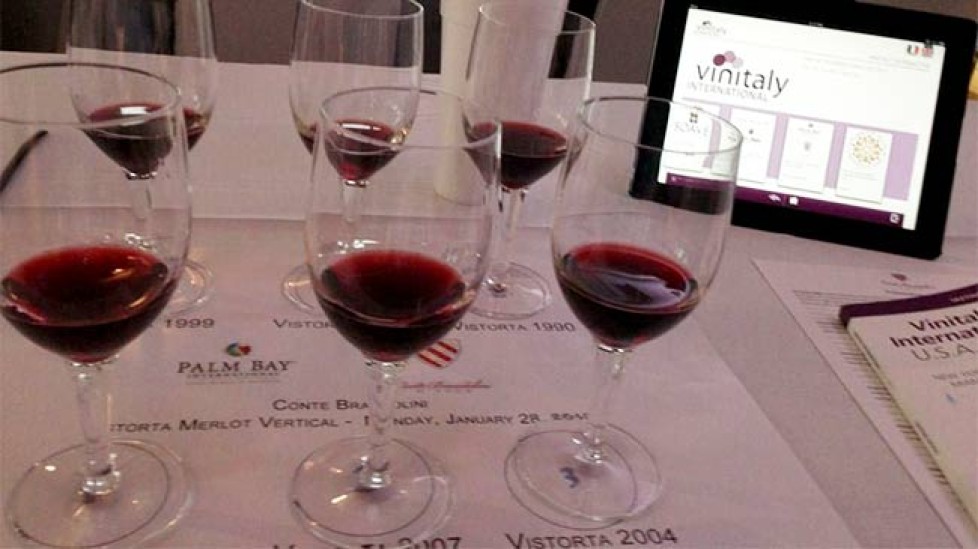
While attending the VinItaly trade show in NYC recently, I had the unique opportunity to attend a “Master Tasting” featuring Conte Brandolini (yes, an actual Count, as well as a winemaker) and 6 vintages of his Vistorta Merlot. It included the current release – 2009, the first release – 1990, and 4 in between: 2007, 2004, 1999 and 1997. Despite Brandolini’s comment that “it’s impossible to really get to know a wine without tasting at least 4 or 5 vintages,” most of us don’t often get the opportunity to compare vintages of any wine side by side, so my expectations were heightened.

Though vertical tastings can go older to younger (increasing in tannin and intensity as the tasting progresses), most go younger to older, as complexity and nuance typically increases with bottle age. True to form, the 2009 Vistorta was tight and tannic, drinkable but seemingly not ready to show its best stuff. As the age increased, the Merlot showed more savory notes, including herbs (especially when a small percentage of Cab Franc was present), stinky cheese, sweat, and tobacco.

All of the Vistorta Merlots are an exercise in elegance and restraint, making it difficult to believe that they’re made from the same grape as their California brethren. Brandolini’s estate is in Fruili, the most northeasterly province in Italy, just north of Venice and west of the Slovenian border, so cool weather abounds. The Count also believes strongly in the importance of balance in wine, keeping the alcohol low so that the wine remains versatile with food. This is not a surprising opinion coming from an Italian, of course, despite the fact that it might make the wine less marketable internationally.

brandolini vistorta merlot

During the tasting, a guy sitting next to me asked me if I knew the price of the wines. Not sure, I whipped out my phone and started researching. “List price in the upper 20s,” I told him. “It’s good, but not great,” he replied. “Not sure I’d pay that.”

“Right now in PA, though, the 2006 Vistorta Merlot is on sale for $11.99,” I mentioned. “I’d definitely pay $12,” he responded with surprised enthusiasm.

I would too. I did, in fact. Available in very limited quantities, I scored a bottle at a nearby state store. Though obviously not tasted alongside the others, the 2006 slotted into my memory alongside the other vintages as I would have expected. It was elegant, featured bright acidity, lovely dark fruits, and subtle notes of earth and tobacco. And forget the traditional Merlot food pairings; this plays more like a Loire Cab Franc or Burgundy Pinot Noir (try it with roast chicken). Having tasted through much of the portfolio, it seems highly likely that it’ll age well for 5-10 more years – how often does one say that about $12 wine? – though it is certainly nice to drink right now.