Warning: Undefined variable $url in /home/undiscov/public_html/undiscovereditaly/wp-content/plugins/twitter-facebook-google-plusone-share/tf_display.php on line 365

Lovely Lagrein

Lovely Lagrein

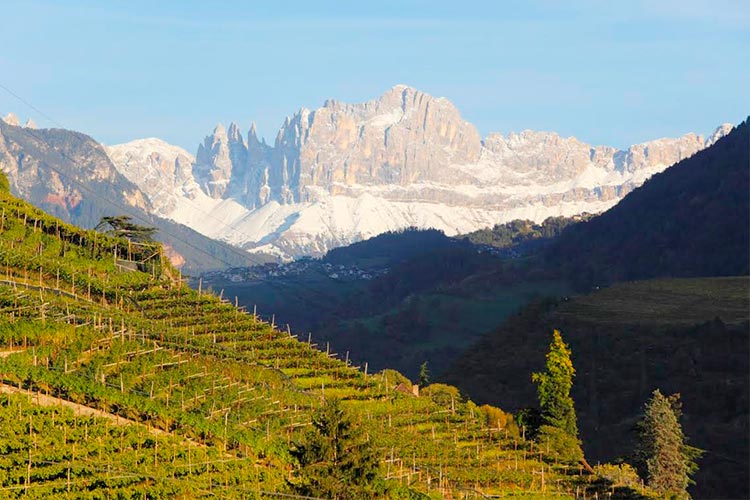
As we discussed in our piece on white wines of the Alto Adige (aka South Tyrol or Südtirol), this northernmost Italian region spent a long time within the Austro-Hungarian empire prior to WWI, and is still heavily influenced by that culture. (On wine labels, for example, German text often appears above or alongside the Italian, as many residents speak German natively.) Thus, given the opportunity to speak with Judith Unterholzner – who represents regional producers Terlano and Andriano – about wines made with Lagrein, a red grape grown almost exclusively here, my first question was whether the winemakers see it as Italian or Austrian. “Lagrein is much more Austrian than Italian in influence,” she told me. “But this is more due the impact of the mountains and the alpine microclimate than the culture.”

In other words, it’s all about terroir. Lagrein don’t care about wars, country borders, or any other man-made conflicts. It found a spot it likes, in a sometimes-unforgiving alpine climate, and it is thriving. In mountainous regions especially, there seems to be a strong bond between the climate and certain grapes, and Lagrein’s match with Alto Adige is no exception. We can come up with all sorts of other ways to describe terroir, but for me, that just about sums it up.

judith-terlano
Judith Unterholzner with Terlano Lagrein

The grape, pronounced “lah-grine” (rhymes with wine), was traditionally used for blending – with the lighter Shiava, mostly – or as a rosato, due to its rugged, bitter nature, and only found its true calling in the early 1980s. “In the decades before,” says Unterholzner, “many consumers wanted lighter, easy-drinking red wines. Then there was an upswing in demand for structured red wines, and more oak influence… Lagrein fulfilled both requests, being full of character and developing fine spicy notes with oak aging. For locals of the region, this became our first serious red wine.”

Tasting through several Lagreins recently, I discovered a refreshing typicity, especially with the non-riserva wines (those aged in large oak casks or steel). Though each wine offered something different – a few featured earthy, rustic notes, for example – there were characteristics that clearly identified every bottle as Lagrein. Aromatically, a violet, floral bouquet recalls Syrah (a cousin), but only just. (La Cucina Italiana identifies this scent as brunelle, a local name for wild orchids found in the region.) On the palate, bright plums and and blackberries lead the way, with black tea and more violet – or brunelle – notes. As it finishes, there’s an almost soapy aspect we’ll call lavender, lest you think it punishment for foul language, which it is most certainly not.

lagrein-alto-adige

Perhaps unsurprisingly, the riservas, or wines aged in small oak barrels – which can cost significantly more – tend to relinquish some of this typicity. Oak softens the floral nature of the aroma, and though spicy flavors on the palate can add intrigue, they also obstruct those special orchids & plums. Riservas are, of course, made for longer aging (10 years or so), but – and take this to heart coming from a lover of aged wine – I’m not sure, in this case, they offer more than the wines meant for everyday drinking.

Pairing-wise, Lagrein of course plays well with the foods of the region, including the legendary speck (smoked, cured ham), as well as beef or game stews. Polenta, mushrooms and root veggies are also common. I love it with fresh pork preparations too, such as grilled chops, roasted tenderloin, or stewed shoulder. Unterholzner suggests braised (in Lagrein, obviously) veal cheek on top of celery root puree.

lagrein-alto-adige

Reviewing my tasting notes, a few things are obvious:

1) Lagrein quality is consistent. Any bottle that’s 15-20 bucks, is certain to be both delicious and representative of the region and variety. In fact, I’ve yet to try one in this price range that wasn’t good, with the exception of one bottle that was cooked. (Which was hardly Lagrein’s fault!)

2) There’s less certainty with riservas. Added winemaker intervention (mainly through oak) means that these wines may represent the region well, but could also taste like modern red wines of indeterminate origin. Of course I only tried two – one of which was on the younger side for a riserva –  and though both were enjoyable, they were generally less appealing. (If anyone out there wants to prove this hypothesis wrong with a beautifully aged bottle, just tell me where and when…)

Without further ado, the notes:

Tiefenbrunner Turmhof Lagrein 2011 ($21)
Big fruit on the nose, alongside a touch of earth and smoke, as well as warm spice. Nice balance of freshness and funk. Good complexity, evolves in the glass. Rustic finish. (92 points)

Balter LagreinTramin Lagrein 2010 ($18)
My favorite nose of the bunch. Moss, forest floor, leather, fruit. Leaps out of the glass. Palate decent too, but almost a letdown after the nose. Still, quite good. (92)

Abbazia di Novacella Lagrein 2009 ($20)
Classic flavors mixed with the modern touch of sweet warm mulling spice and tobacco. Good acidity, big tannins, and intriguing complexity. (91)

Peter Zemmer Lagrein 2010 ($18)
The most typical of the group. This is the pure essence of Lagrein. Straightforward, with all the expected aromas and flavors. (91 points)

Azienda Agricola Balter Lagrein IGT 2010 ($18)
Nice balance of earth, spice and herbs to go alongside the plum and fig. Smooth. (90)

Andriano Tor di Lupo Riserva 2010 ($40)
Classic Lagrein notes are there, but made more subtle by warm spice and tobacco. Hints of earth and tar on the nose, especially with air. Big tannins, bitter on the finish. Should improve with age. (89+)

St. Paul’s Lagrein Gries 2010 ($21)
Rich, dense fruits with a discernable chocolate/cocoa element. Would benefit from air and/or little time. (88)

Terlano Lagrein Porphyr 2006 ($50)
The least Lagrein-like personality, perhaps due to overdone oak. Dark fruits, lots of warm spice, some fleeting earth. Not bad, but nothing special for the price. (87)
Pairing Pesto

Pairing Pesto

One of my absolute favorite things about summer is fresh basil from the garden. I use it widely, but mostly with fresh tomato sauce, pizza, sandwiches, and, of course, pesto. But, it’s also getting to be that time of year when I notice that my basil plants are getting a bit old and tough, and that they probably should have been harvested weeks ago. Luckily, it’s not too late. Though using young, soft leaves that are shorter than three inches at the spine is best for authentic Genovese pesto, giving older leaves a quick blanch and soak in ice water can still bring deliciousness. (If you’re in the Philly area, you might also check out my Great Pesto Challenge piece over at Small Food.)

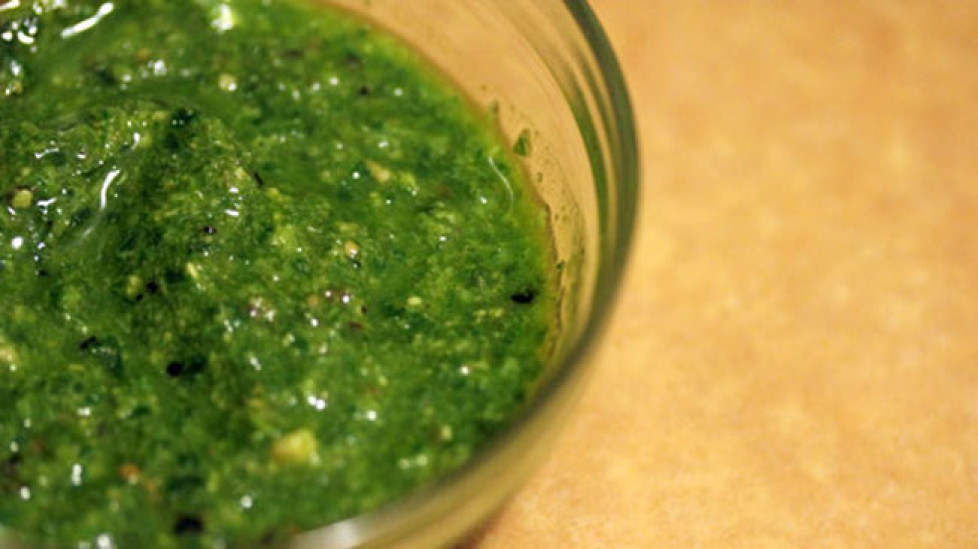
Pairing pesto with wine can be difficult. (For clarity, we are talking about a traditional pesto of basil, garlic, pine nuts, EVOO and Parmesan.) The sauce is both pungent, with assertive flavors from the garlic and cheese, and delicate, as basil has quite a bit of nuance. Generally, whether looking for white or red wine, young, fruity, aromatic wines are far better than anything aged, overripe, oaky, or flabby. Good pesto is bright and fresh, so you want to find a wine that exhibits similar traits. Of course, another key consideration is what you are serving with the dish. A simple pasta dish dressed with pesto, for example, will probably work better with a white wine, but the addition of heartier ingredients such as sausage or tomatoes make red a viable option.

argiolas-costamolinoAs is the case for most Italian food, the safest bet with any pairing is to follow the rule “if it grows together, it goes together”. Genoa, pesto’s homeland, is in Liguria, a small region on the Mediterranean coast just northwest of Tuscany. The indigenous white grape here is Vermentino, which makes lovely wines that offer rich flavors of tropical fruit but also bring great acidity, matching the dual personality of its sister sauce. Ligurian Vermentino is not exactly easy to come by in our area, but Sardinia’s Argiolas makes an excellent option – Costamolino ($14.99) – which is widely available and delicious for the price. Of course, other aromatic northern Italian whites can also work well, including Ligurian Pigato and Bianchetto Genovese, plus Arneis, Gavi and Soave.

On the red side, we can look to the simple red wines of neighboring regions Tuscany and Piedmont for good pesto partners. Think a young, inexpensive Chianti or Barbera that is bright and fruity, with perhaps a touch of earth.

If Italian wine is not your thing, we can use the same principles to pair international varieties to the sauce. Chardonnay’s tendency to be oaky and buttery, for example, means it is probably worth avoiding, unless you know you are getting an acidic, un-oaked version. Sauvignon Blanc, on the other hand, has that bright, herbal character that could work here. Southbank Estate Sauvignon Blanc Marlborough, for example, features a strong citrus note that could bring out the best of the pungent sauce. Vibrant whites from Northwest Spain, such as Albarino and Godello, are also worthy of consideration. The Martin Codax Albarino ($14.99), which is widely available, has a touch of oak for softness (as the grape can be very austere), but enough acidity to cut through any richness.

New world red wines can be difficult because of their tendency to be ripe, concentrated and oaky, all of which would clash with pesto’s soul. Looking to France, however, could yield dividends, especially young, fresh Pinot Noir, Cru Beaujolais (try a Henry Fessy), or Loire Cab Franc (maybe even one from Long Island), all of which bring great acidity and herbal character. In California, a cool-climate Zinfandel or Pinot Noir with similar characteristics could pair nicely, especially if some meat is involved.

Lastly, let’s not forget about Rose. It goes with everything, especially over the summer. Not much more to say there.

What have you paired with pesto? What worked and what didn’t? Comment below.

Alto Adige Ascension

abbazia-di-novacella

The Geography geek in me gets excited whenever we talk about Northeastern Italy, an area rife with annexations, takeovers and other conflicts of land ownership. The region – especially Trentino & Alto Adige, also known as South Tyrol – is one of the areas of Europe that has been passed back and forth so many times that languages and culture are permanently blurred. Much like Alsatian France is distinctly German, this area of Italy takes the lead from Austrian culture, as it was part of the Hapsburg Empire through World War I. In fact, so entrenched is the German language that it often takes prominence over the Italian on wine labels.

That said – as Frank is fond of saying – there really is no such thing as “Italian Wine”, because there is so much variation in both climate and culture as you move around the boot. Still, Italian white wine often fights the stigma that it all tastes the same, and doesn’t taste very good. Northeastern Italy is certainly to blame for that, with much bulk, inert Pinot Grigio coming out of the Veneto region, but that’s still only one perspective.

In Alto Adige, for example, although Pinot Grigio is widely grown and vinified, there’s a more serious focus on creating quality cool-climate white wines. Though many can be light and crisp due to the southern alpine growing conditions, there’s variety and quality here that is worth getting to know.

Recently I had the chance to drink through a number of wines from Abbazia di Novacella, a 12th century Augustinian abbey located less than 30 miles from the Austrian border in Alto Adige. The abbey – which, interestingly, is listed on Google maps as “Kloster Neustift”, the German name – has been crafting wine for more than 850 years, but has more recently garnered acclaim via their very own 2009 Italian winemaker of the year Celestino Lucin.

As the whites that I tried were vinified in stainless steel, there was a unity in style with regards to intense aromas and mouth-watering acidity of the cool climate grape, however they did also offer some noticeable variations in style.

The Muller Thurgau (SLO in PA, Code 71089, $20.69, minimum 12), for example, is probably lightest, with a bright, citrusy flavor and easy-going personality that screams summertime white. In contrast, the Gewurztraminer (only the 1996, strangely, is available in PA, SLO 59249, $16.49, min 12) is full-bodied, with lush notes of tropical fruits and Asian spice, perfect for Fall.

Novacella’s  Sauvignon (not available in PA) offers that austere, grassy note that Sauvignon Blanc is known for on the nose, but is nicely ripe and juicy on the palate. If the cat pee of Sauv Blanc turns you off, this will be no different, but it’s a very nicely done old-world style SB for those who appreciate the mouthwatering properties.

Lastly was the Kerner (SLO Code 527816, $19.99, min 1) a hybrid grape from Riesling and Shiava that drinks like a dry riesling – great aroma, bright acidity, and perhaps just a touch of sweetness on the palate.

In the end, each wine offered something different, yet all were mouthwatering and delicious, and I’d highly recommend picking up wines from AdN or others in the Alto Adige region if and when you come across them.

There are a few Abbazia di Novacella wines in PA stores, though your best bet may be the SLO (Special Liquor Order) program, with codes noted above. Wine Works in Marlton, NJ (just past Cherry Hill), Wine Library in Springfield, NJ (delivers to PA) and Wine.com (delivers to PA) also carry AbN wines.

Full disclaimer: Review samples of these wines were provided.

Cantine Rialto La Contessa Rosso 2011

la-contessa-rossoThe vagaries of wine sales often have us finding new wines at times that don’t really mesh with when one might actually want to drink said wine. It’s July, and though it seems to rain every darn day, it’s also pretty hot. Still, a few times I’ve  managed to talk myself into a red wine that’s too big/complex for the season, only to dream of drinking a Rose over dinner.

Cantine Rialto’s La Contessa, a Merlot blend featuring 10% each of Sangiovese and Sagrantino, falls into this category. Though it can certainly be enjoyed now in some primo air conditioning, it’s full-bodied nature and prominent tannins are better saved for the temperatures and foods of fall and winter. Of course, never knowing how a particular wine will sell in the system, I’d suggest picking up a few bottles now and stowing them away in a cool basement corner or wine fridge for later enjoyment. (It should drink well for at least 5 years.)

As for the wine itself, in true Umbrian fashion, it is rustic, a little funky, and delicious. The nose is an interplay of earth, spice and dark fruits, which continues for the most part into the palate. Though this saw some new oak, it is understated and adds a nice complexity. The blend only features 10% Sagrantino – Umbria’s great grape – but the spice, tannin and truly unique character of one of my favorite varieties is hard to miss on the finish. Overall, this is a great wine for $13.99 (in PA), and one that would probably sell for at least double the price were the label to say Tuscany instead of Umbria.

Celli Bron & Ruseval Sangiovese-Cabernet 2010

celli-bron-ruseval-sangiovese-cabernetOne of my biggest gripes with the Chairman’s Selection program is that when I find a wine to love, the odds I’ll see the next vintage of that same wine in PA are miniscule. This is, I suppose, the problem with relying on the power of bulk and opportunistic buying.

That said, it does seem recently that certain producers show up repeatedly in the program, even if the wines themselves differ. Celli, a producer from the oft-overlooked Italian region of Emilia-Romagna, is one of those producers. Last year, I absolutely loved their Le Grillaie Riserva Sangiovese di Romagna (we’ll call it SdR for short), a Chairman’s Selection that was rustic and earthy, but featured bright fruit and excellent balance, so when I saw another wine from Celli enter the program – this time, the Bron & Ruseval Sangiovese-Cabernet ($19.99) – I of course jumped right on it.

In contrast to the SdR, which was 100% Sangiovese, the Bron e Ruseval is a 60/40 mix of Sangiovese and Cabernet, or Celli’s version of a SuperTuscan. (SuperRomagnan?) As such, it’s more modern in style, with a velvety and luxurious mouthfeel, as well as hints of dark fruit, vanilla and spice. Still, the Sangiovese has room to shine, offering herbal notes, leather and red cherries. It’s quite nice to see a wine live up to its promised double billing – unlike so many SuperTuscans that are dominated by the “global” varieties.

At nearly $20, this wine isn’t the everyday bargain the SdR was, but it is a serious wine worthy of serious cuisine (a well-made Bolognese would work, as would a big hunk of beef) that suggests serious aging potential. I’ll certainly be picking up a few more bottles for my cellar.

Mastroberardino Lacryma Christi del Vesuvio Rosso 2011

Of Positano, Italy, John Steinbeck once wrote: “Positano bites deep. It is a dream place that isn’t quite real when you are there and becomes beckoningly real after you are gone.” In some ways, one might say this about any vacation destination, or perhaps even the act of going on vacation at all (at least for those of us who hold day jobs), but having visited Positano several years ago, I can attest that Steinbeck’s words are eerily prophetic in this particular scenario. There’s just something about the place that has caused it to increasingly and consistently grow in stature in my mind as more days pass since my visit.

The reason for this lengthy aside is that, while visiting Postiano, we drank at least one bottle of Mastrobeardino Lacryma Christi del Vesuvio each day. It was truly the perfect wine for the situation: a friendly, local red that paired well with a variety of foods, including fresh seafood, as well as panoramic ocean views. The question, of course, that one has to ask, however, is whether the wine has grown in stature in our minds since we left Positano. Was it really all that good, or was it the ocean views? Which reminds me of another great quote, from wine writer Bill St. John: “The reason you do not get headaches from drinking wine on vacation is that you are on vacation.”

All that said, my radar obviously went off when I saw our very own Positano wine coming into the CS program for $14.99. (Though $15 is not dirt cheap by any means, this wine sells for $23 at Total Wine, so it is certainly a good opportunity to grab some.)

But, you are surely wondering, did it live up to the hype of my memory? Really, how could it have? I drank it at home, indoors. That said, it is very much an enjoyable wine that will pair nicely with good friends, a deck or patio and the warmer months ahead. It’s medium-bodied, features floral notes, herbs and plummy dark fruits. After several hours of air, a smoky, ashy note was evident as well, adding complexity and taking me back to the volcanic skyline of Campania.