[parallax-scroll id=”6014″]
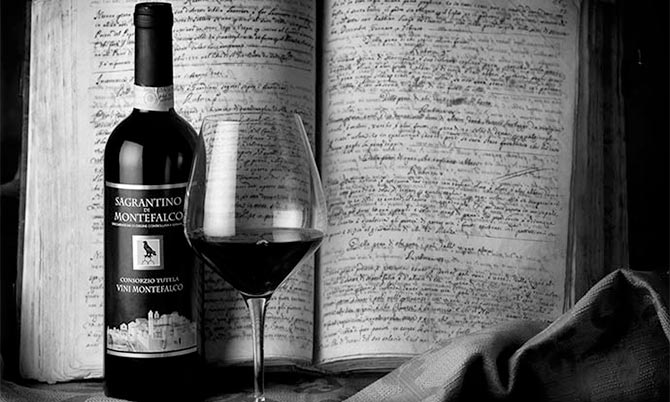
It’s July 20-something, and the relentless midsummer sun is bearing down on the Northeast US. Rosé Season is in full swing. It’s the time of year when my brooding, prized behemoths normally slumber safely in the dark, dusty confines of my cellar, awaiting the return of fall and temperatures more appropriate for their masculine wiles. Yet here I sit, in the company of one of the baddest dudes on the planet: the fabled Sagrantino di Montefalco. As its singular, rugged aroma wafts out of the glass, intermingling with the redolence of pork seared alongside generous doses of fennel pollen, garlic and sage, I begin to realize that, in spite of Mother Nature’s attempts to dissuade me, this may be one of the better decisions I’ve made in some time.
Regardless of season or context (and ignoring for a moment the cooling embraces of my brand new HVAC system), this is one extraordinary wine. I could claim it’s the bold flavors of dark cherry, pipe tobacco, warm spices, resinous pine tar, anise and mocha that set it apart, but winespeak won’t do it justice. There’s something here I can’t put my finger on, a unique, special, even majestic aspect that separates it from the rest.
Sharing this moment with me is Frank Cipparone, the former lead Italian instructor at Philly’s Wine School and a fellow Sagrantino lover. “I was once asked,” muses Frank, “if I could only choose to save one grape, which it would be. It was an easy choice: Sagrantino.” I ask him what sets this grape apart. “What defines it for me,” he replies, “is the balance of complexity and subtlety, power and grace. When you inhale the seductive, earthy aromas of a well-made Sagrantino, you know it can only be Italian. As it opens up from one sip to the next, it represents what any Italian wine should be – authentic, uncompromising, and true to its place of origin. Chianti may be Italy’s most famous wine,” he continues, “but Sagrantino is the real thing.”
Italy’s Heartland
Often called il cuore verde d’Italia (the green heart of Italy), Umbria is a landlocked region that sits almost dead-center on the boot, with a similar climate to Tuscany, spotted with hill towns and lush, fertile valleys, a wonderful locale for much of Italy’s finest olive oil, truffles, game meats and, of course, grapes. (Those who can live with being further from Florence will find far lower rental prices and less crowded streets too, but that’s another conversation.)
If Umbria is the heart, Montefalco is the beat, located in the center of the center, and though its wines are perhaps not as well known to casual drinkers as Orvieto’s crisp whites or the famed Lungarotti family of Torgiano, it holds the trump card: Sagrantino.
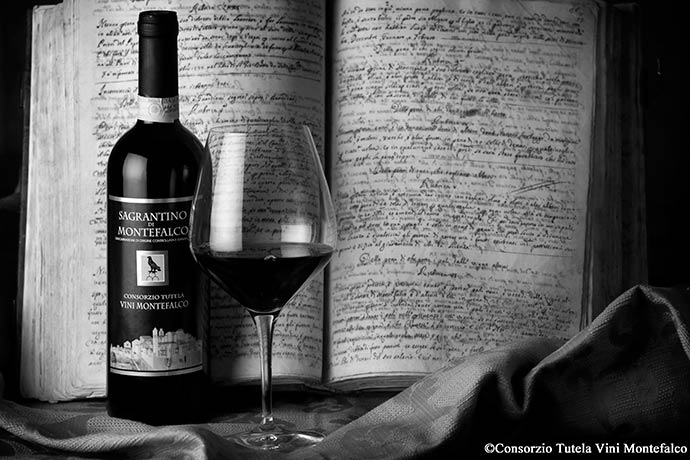
There’s a shroud of mystery over the origins of this grape; digging into to the topic will unearth tales of Pliny the Elder, St. Francis of Assisi, and the Saracens of Spain. Has it been here since the dawn of time? Does it matter? It’s here now, and it shines in this spot, above all others; a potent, rustic beauty for Umbria and Montefalco to claim as their own.
Much of Sagrantino’s unique personality is derived from its thick skins, which contain more polyphenols than any other vinefra (which in turn creates fiercely tannic wines). Historically, to combat this unrelenting bitterness, monks producing sacrament wine air-dried the fruit to concentrate sugars, then vinified it as sweet passito.
In the 1970s, as the grape neared extinction, a group of Montefalco-based winemakers began to experiment with dry Sagrantino, using modern techniques to tame the exuberant tannins. In particular, the success of the Arnaldo Caprai estate established worldwide interest in the grape and region, helping to create a DOC in 1979 and elevating the Sagrantino di Montefalco – wines made with 100% Sagrantino grapes – to DOCG status (the highest classification of Italian wine) in 1992.
In the 1990s – and even as recently as 5-7 years ago, to be honest – it was nearly unheard of to find a bottle of Sagrantino di Montefalco for less than $50, due to the grape’s rarity – only 250 acres were under vine in all of Montefalco. In the years since, however, the area has seen vast growth, nearing 2000 acres today. Between the years 2000 and 2008, Sagrantino production quadrupled, while the total surface area of DOCG vineyards has grown to 5 times its original size (although a reduction in the yield per hectare has also been implemented, to preserve quality).
Because of this expansion, as well as the addition of new producers, the market has opened for competition and allowed for more favorable consumer pricing. Always looking for these bottles myself, I’ve noticed lately that finding one under $20 – though still unlikely – isn’t the white whale it once was.
As such, it’s an exciting time to be a Sagrantino drinker. More competition, modern techniques, increased distribution and better pricing means it is easier to procure a great bottle of this wonderful wine than ever before.
[parallax-scroll id=”6018″]
My Week With Sagrantino
My midsummer Umbrian adventure – in Pennsylvania – begins with the Montefalco Rosso DOC, a red made with mostly Sangiovese and just a small amount of Sagrantino. Interestingly, just few weeks ago (late June 2015), the Montefalco Consortium’s board of directors voted to change the blending rules for this wine, removing the requirement for a third grape while encouraging the use of more Sagrantino (up to 25% from the current max of 15). This prioritization of terroir over all else is a bold statement in today’s world of modern, homogeneous winemaking.
Since the wine I am drinking – Antonelli Montefalco Rosso – is from the 2010 vintage, it features the traditional blend of Sangiovese (70%), Sagrantino (15%), and, in this case, 15% Merlot. The strong foundation of Sangiovese makes for a wine that plays like other Central Italian reds: medium-bodied, fresh red fruits, hints of dirt and leather, food-friendly. The addition of Sagrantino, however – even just a little – adds a distinctly Umbrian robustness.
As I taste my nearly finished marinara sauce made from local tomatoes, I begin to worry that this particular heirloom variety might be too fruity for the Sagrantinian finish. And the wine has already been poured! Thankfully, the Sangiovese plays its role, staying light on its feet — and though tannins are certainly present, the firm acids from both Italian grapes play well off of the brightness of the sauce. This would clearly pair well with a wide variety of pastas, pizzas and similar first courses.
A few days later, a barbecue with friends brings out bottles of the Cantine Rialto Umbria Rosso 2012, another blend of Sangiovese, Sagrantino and Merlot, this time with Merlot in the lead role, thus its categorization as the more generic Umbria IGT, despite its obvious roots in Montefalco. This wine is perhaps the ultimate everyday Umbrian – Merlot delivering its soft, plum fruitiness up front, followed by Sagrantino mixing in a dash of its unmistakably spicy character on the finish. Finding a few bottles on sale for $8.99, it’s a no-brainer to stock up on for sausages hot off the grill, (and easy to open another when the last drop is poured).
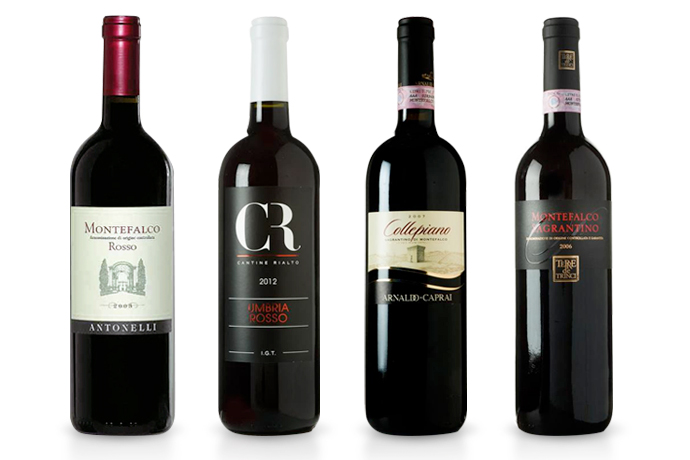
Throughout this discussion, I’ve been alluding to the weather, the food, and the weight of the wine, how this all comes into play with regards to when and where we drink it. Especially now that we are eating healthier as a society, it’s interesting to think about the big, bold wines and what foods they pair with. Do they always need a big, fatty hunk of beef? A few months back, I came across an article in Saveur magazine about Umbria, and was particularly intrigued to see pairing suggestion of Arnaldo Caprai Sagrantino di Montefalco Collepiano – a giant in the space – with pork tenderloin, an extremely lean meat. Could this actually work?
More importantly, is there something in particular about Sagrantino that makes it work? In Ian D’Agata’s awe-inspiring tome Native Wine Grapes of Italy, consulting winemaker Emiliano Falsini opines that Sagrantino skins, “despite their wealth of polyphenols… can be put through even long macerations, because the tannins are usually smooth and polished.” This is in contrast to other grapes, which Falsini notes risk “leaching out very dry astringent tannins” with longer macerations. (page 426, hardcover edition)
The recipe in question – Filetto di Maiale con Bacche di Ginepro (Pork with Juniper Berries) – relies heavily on regional herbs and spices, namely juniper, fennel, sage, rosemary & thyme. (There’s some pancetta or guanciale too, in fairness, but not that much.) I give the wine, a 2007, about 3 hours of air before dinner, and it opens nicely by the time food hits the table. There’s this element of medicinal herbs to Sagrantino – which might sound odd when written, but is actually quite brilliant in juice form – that a dish like this teases out oh-so-perfectly.
Wow.
A bite of that pork, with the juniper, fennel, herbs, and then the wine. It’s like a symphony, one unified movement, flowing together, continuing long after the bite or sip has concluded. Simply gorgeous.
And the tannins? Nicely polished indeed, with lots of chocolate on the finish. They certainly make no attempt to thwart my enjoyment of the meal.
Finally, my food and wine journey concludes back where it started – with tomato sauce, but, this time – because how could I not – there’s pork involved. A ragu, to be specific. I’ve pulled a lower-priced Sagrantino DOCG, the Terre de Trinci Sagrantino di Montefalco 2006, which I somehow scored for less than 15 bucks a couple years ago, and have been patiently storing since, slowly coaxing its subtle charms into being. It brings all the classic notes of earth, anise, macchia, warm spice and bold cherry fruit, and though perhaps not as complex as the Caprai, it emboldens the soul next to a plate of pasta made with love.
What else does a guy need?
All images exc bottles © Consorzio Tutela Vini Montefalco

 The vagaries of wine sales often have us finding new wines at times that don’t really mesh with when one might actually want to drink said wine. It’s July, and though it seems to rain every darn day, it’s also pretty hot. Still, a few times I’ve managed to talk myself into a red wine that’s too big/complex for the season, only to dream of drinking a
  Those obsessed with (or perhaps mildly interested in) rare, unique or different grape varieties should take particular note of Sagrantino. Almost exclusively grown in a small area of Umbria – hardly the most heralded wine region in Italy – the dry form of this juice is a relatively new addition to the fine wine world. Because of the grape’s thick skin and thus intense tannins, for many years it was only used to make passito (sweet wine made from dried grapes). In the 1970s, however, several Umbrian producers brought it back from near extinction and proved it could make a hearty, unique dry wine. Sagrantino di Montefalco gained DOC status in 1980, followed by the coveted DOCG status in 1992.