Warning: Trying to access array offset on false in /home/undiscov/public_html/undiscovereditaly/wp-content/plugins/twitter-facebook-google-plusone-share/tf_display.php on line 401
Warning: Undefined array key 0 in /home/undiscov/public_html/undiscovereditaly/wp-content/plugins/twitter-facebook-google-plusone-share/tf_display.php on line 378
Warning: Undefined variable $url in /home/undiscov/public_html/undiscovereditaly/wp-content/plugins/twitter-facebook-google-plusone-share/tf_display.php on line 365
Of Positano, Italy, John Steinbeck once wrote: “Positano bites deep. It is a dream place that isn’t quite real when you are there and becomes beckoningly real after you are gone.” In some ways, one might say this about any vacation destination, or perhaps even the act of going on vacation at all (at least for those of us who hold day jobs), but having visited Positano several years ago, I can attest that Steinbeck’s words are eerily prophetic in this particular scenario. There’s just something about the place that has caused it to increasingly and consistently grow in stature in my mind as more days pass since my visit.
The reason for this lengthy aside is that, while visiting Postiano, we drank at least one bottle of Mastrobeardino Lacryma Christi del Vesuvio each day. It was truly the perfect wine for the situation: a friendly, local red that paired well with a variety of foods, including fresh seafood, as well as panoramic ocean views. The question, of course, that one has to ask, however, is whether the wine has grown in stature in our minds since we left Positano. Was it really all that good, or was it the ocean views? Which reminds me of another great quote, from wine writer Bill St. John: “The reason you do not get headaches from drinking wine on vacation is that you are on vacation.”
All that said, my radar obviously went off when I saw our very own Positano wine coming into the CS program for $14.99. (Though $15 is not dirt cheap by any means, this wine sells for $23 at Total Wine, so it is certainly a good opportunity to grab some.)
But, you are surely wondering, did it live up to the hype of my memory? Really, how could it have? I drank it at home, indoors. That said, it is very much an enjoyable wine that will pair nicely with good friends, a deck or patio and the warmer months ahead. It’s medium-bodied, features floral notes, herbs and plummy dark fruits. After several hours of air, a smoky, ashy note was evident as well, adding complexity and taking me back to the volcanic skyline of Campania.
Giovanna Tiezzi of Pacina Winery (img via Facebook)
The recently celebrated International Women’s Day took on a decidedly Italian accent with “La Festa Della Donna” at Osteria in Philadelphia, a dinner honoring four of Italy’s female winemakers. From Elisabetta Foradori in Trentino to Sicily’s Arianna Occhipinti, the emergence of women taking a leading role in viticulture is noteworthy in a country long thought of as a bastion of Old World tradition. In some cases, the patrimony of legendary estates such as Bartolo Mascarello, Bruno Giacosa, and Gianfranco Soldera has passed to and been stewarded by their daughters. In others, like Elisa Semino of Piedmont’s La Colombera, women work alongside fathers and/or brothers.
A common philosophy and approach to winemaking brought together the terroir-breaking representatives at the dinner. Each is committed to organic and biodynamic practices; minimal, non-intrusive techniques in the cellar; and limited production of artisanal wines, less than 4000 cases per year, relative drops in the international wine ocean. As they spoke to the assembled guests, there was an evident yet understated pride in their craft, tempered by a humility that acknowledged their reliance on and reverence for the soil in which they work.
The wines selected for the evening are distributed by The Artisan’s Cellar, a West Chester based facility, and can be ordered through the PLCB’s special order procedures.
Silvana Forte, Le Due Terre
In the eastern hills of Friuli, hard by the Slovenian border, Silvana and husband Flavio Basilicata make wine from indigenous and international grapes. No technology intervenes in their traditional methods, such as the use of natural, native yeasts to promote spontaneous fermentation.
Sacrisassi Bianco 2010, Colli Orientali DOC (PA SLO #528132, $49.19) A blend of local varietals, 70% Friulano (formerly known as Tocai Friulano) and 30% Ribolla Gialla. Unlike many white wines, this stays with you from the intense, focused aromatics of ripe orchard fruits to its lingering aftertaste. Vigorous minerals, the typical salinity found in this area’s wines, and crisp acidity keep the medium body fresh and lively. (89-91)
Valeria Gurrieri, Vini La Favola
The husband and wife team of Valeria and Corrado preside over vineyards on Sicily’s southern coast near the town of Noto. They and the land he inherited are one, and every aspect of their winemaking, from vine to bottle, reflects a synergy absent in mass-produced wine.
Fravolato 2010, Sicilia IGT (#527399, $21.29) Spicy, lively, persistent, flavorful, zesty – just a few of the adjectives that describe a wine fermented in steel by select native yeasts. There’s an undeniable Sicilian earthiness at the core of red berry and cherry flavors from Nero d’Avola, and the 40% Frappato brings a refreshing acidity that tones down some of its partner’s rustic edge. For those who still hold to the idea that red wine doesn’t pair with fish, this was creatively served with pistachio crusted tuna and couscous, a nod to the Arabic influences in Sicilian cuisine. (90-92)
Giovanna Tiezzi, Pacina
Pacina has been described as the “Godfather” of the organic farming movement in Tuscany. Situated in Castelnuovo Berardenga, on the meandering border of Chianti Classico and the Colli Senesi, Giovanna Tiezzi and husband Stefano Borsa produce wine that is not manipulated through technology, resulting in pure expressions of Sangiovese and other grapes.
La Malena 2007, Toscana IGT (#514321, $38.59) A 100% Syrah vinified in concrete tanks, then transferred without filtering to age in large oak casks – and it shows. The mildly leathery, herbal nose says Tuscany, but the mouth just wraps itself around layers of dense, dark fruits with subdued elements of the game, earth, and pepper you’d expect from the varietal. A “big” wine that calls for a comparable food pairing, such as bistecca alla Fiorentina. (90-92)
Summer Wolff, Cantine di Indie
She may not have an Italian name, but she does reside in the Monferrato hills of Piedmont (with fiancé Fabrizio Iuli, a master of powerful, evocative Barbera), and is the driving force behind Indie Wineries, a company that champions and imports the products of boutique wineries throughout the peninsula as well as from France, Slovenia, and California. The wine Summer poured at the dinner is her first label – and, with the positive reactions of the crowd, hopefully not her last.
Vino di Popolo 2011, Langhe DOC (#528131, $17.19) Woodsy scents of the Langhe hills and fruitiness from the region’s stalwart trio of Nebbiolo (50%), Barbera (30%), and Dolcetto (20%) immediately rise from the glass. This has the feel of an everyday wine, a “people’s wine”- earthy and approachable at the same time; flavorful without being overtly juicy; mildly tannic but with an acidic lift that keeps it lively and on target. Someone please pass the agnoletti stuffed with veal (sort of a Piedmontese ravioli) or tajarin (thin pasta ribbons) with a meat ragu! (88-90)
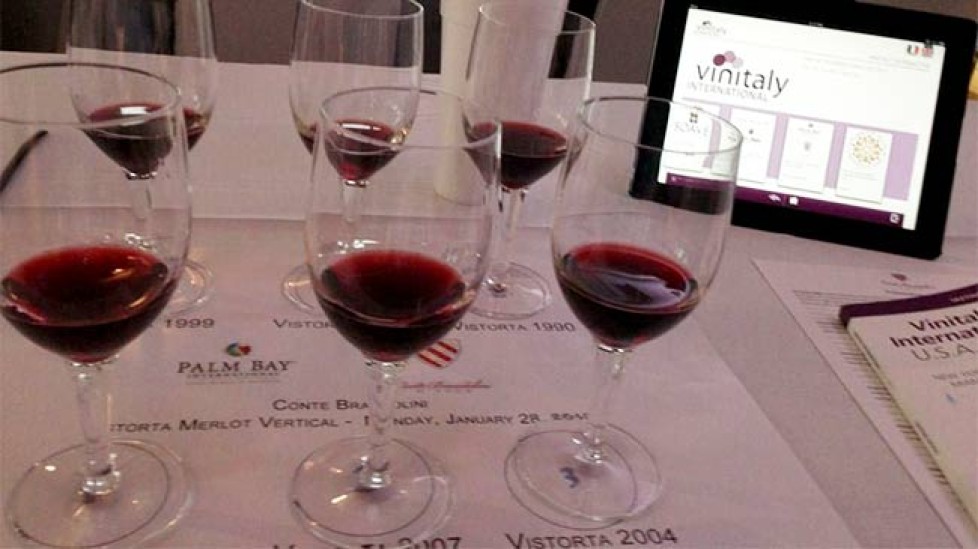
While attending the VinItaly trade show in NYC recently, I had the unique opportunity to attend a “Master Tasting” featuring Conte Brandolini (yes, an actual Count, as well as a winemaker) and 6 vintages of his Vistorta Merlot. It included the current release – 2009, the first release – 1990, and 4 in between: 2007, 2004, 1999 and 1997. Despite Brandolini’s comment that “it’s impossible to really get to know a wine without tasting at least 4 or 5 vintages,” most of us don’t often get the opportunity to compare vintages of any wine side by side, so my expectations were heightened.
Though vertical tastings can go older to younger (increasing in tannin and intensity as the tasting progresses), most go younger to older, as complexity and nuance typically increases with bottle age. True to form, the 2009 Vistorta was tight and tannic, drinkable but seemingly not ready to show its best stuff. As the age increased, the Merlot showed more savory notes, including herbs (especially when a small percentage of Cab Franc was present), stinky cheese, sweat, and tobacco.
All of the Vistorta Merlots are an exercise in elegance and restraint, making it difficult to believe that they’re made from the same grape as their California brethren. Brandolini’s estate is in Fruili, the most northeasterly province in Italy, just north of Venice and west of the Slovenian border, so cool weather abounds. The Count also believes strongly in the importance of balance in wine, keeping the alcohol low so that the wine remains versatile with food. This is not a surprising opinion coming from an Italian, of course, despite the fact that it might make the wine less marketable internationally.
During the tasting, a guy sitting next to me asked me if I knew the price of the wines. Not sure, I whipped out my phone and started researching. “List price in the upper 20s,” I told him. “It’s good, but not great,” he replied. “Not sure I’d pay that.”
“Right now in PA, though, the 2006 Vistorta Merlot is on sale for $11.99,” I mentioned. “I’d definitely pay $12,” he responded with surprised enthusiasm.
I would too. I did, in fact. Available in very limited quantities, I scored a bottle at a nearby state store. Though obviously not tasted alongside the others, the 2006 slotted into my memory alongside the other vintages as I would have expected. It was elegant, featured bright acidity, lovely dark fruits, and subtle notes of earth and tobacco. And forget the traditional Merlot food pairings; this plays more like a Loire Cab Franc or Burgundy Pinot Noir (try it with roast chicken). Having tasted through much of the portfolio, it seems highly likely that it’ll age well for 5-10 more years – how often does one say that about $12 wine? – though it is certainly nice to drink right now.
Those obsessed with (or perhaps mildly interested in) rare, unique or different grape varieties should take particular note of Sagrantino. Almost exclusively grown in a small area of Umbria – hardly the most heralded wine region in Italy – the dry form of this juice is a relatively new addition to the fine wine world. Because of the grape’s thick skin and thus intense tannins, for many years it was only used to make passito (sweet wine made from dried grapes). In the 1970s, however, several Umbrian producers brought it back from near extinction and proved it could make a hearty, unique dry wine. Sagrantino di Montefalco gained DOC status in 1980, followed by the coveted DOCG status in 1992.
Because of the aforementioned thick skin, Sagrantino contains the highest levels of polyphenols (such as tannins) of any grape, which adds both intense flavor and the potential risk of overwhelming bitterness and acidity. As such, it’s a difficult grape to work with, but can yield exciting results when handled properly. Well-made Sagrantinos feature pronounced earthy and vegetal aromas along with rich, inky color and flavor that develops with bottle age.
Because Sagrantino is both rare and difficult, it’s almost unheard of to find a bottle for less than $30, so I took immediate note of this Montechiara Chairman’s Selection in Pennsylvania, newly available for just $19.99. It’s hard to imagine any Sagrantino that wouldn’t, at the very least, be worth a try for less than $20. As an added bonus, the modest bottle age here means the wine is probably ready to enjoy right away.
This particular wine isn’t the best Sagrantino out there, but it’s quite good and certainly a worthy purchase. The aroma starts out quite vegetal, but over time (be sure to give this puppy at least 60 minutes in the decanter!) develops earthy and warm spice aromas. (All Sagrantino di Montefalcos must age for at least 12 months in oak.) On the palate, it features rich dark cherries, with an almost medicinal heat on the finish. The tannins are certainly there, but alongside a dish with meat, they are well-integrated.
All in all, an enjoyable experience at a great price.
If you drink wine long enough, and drink enough of it, you’ll likely run into a fallow period when your level of satisfaction and the number of WOW moments you encounter are few and far between. November was that sort of month. I hit the Clint Eastwood trifecta – the good, the bad, the ugly. Even the wines worth mentioning were, at best, drinkably acceptable. Nothing that made my palate thank me for opening the bottle. Not one wine that made my day.
Fortunately, as the calendar turned to December, my vinous spirits got a much needed and appreciated resurrection with a little help from my friends. Luncheon at a well-known Manhattan enoteca yielded an Andre Clouet NV 1911, a Blanc de Noirs blended from three excellent vintages of the mid-‘90s, of which only 160 cases were made; a pairing of two Barolos-a 2007 Bartolo Mascarello and Renzo Seghesio’s 1996 “Pajana” Gran Riserva; a 1998 RiojaGran Riserva “904” from La Rioja Alta; and a 1987 Fiorano Semillon from the vineyards of an eccentric Italian aristocrat whose story is a tale for another day. Additionally, a colleague just back from a viaggio di vino in Tuscany shared a Castello dei Rampolla “Trebianco”, a truly bio-dynamic mix of three varietals fermented and aged in terra cotta amphorae.
New Year’s Eve was the occasion to uncork what was the most intriguing and thought-provoking wine of what had already been as interesting and rewarding a stretch of imbibing as I’d had in years – Antonio Ferrari Il 1949, a 100% Primitivo with over six decades of maturity.
To break down and describe the elements of this masterpiece would be a disservice, akin to dissecting the brushstrokes on a Van Gogh. There are moments when it’s better to let the wine tell its own story. Italians would refer to this extraordinary example of pre-modern winemaking as a vino di meditazione, a wine to savor unaccompanied by food, but which generates contemplation of the inherent veritas in vino.
As I sipped, and as the wine evolved from glass to glass, my thoughts turned to the year of its birth, of what Ferrari envisioned as he patiently aged the wine for decades before consigning it to bottles for further maturation. Of how the vineyards looked during the growing season, and the smell of the earth. The decisions that were made, and the labor involved, in nurturing the grapes from bud break to resting in large, old casks. It was a time before temperature controlled fermentation, before barriques became universal. A simpler time when a farmer’s understanding of the soil and its capabilities wasn’t analyzed and quantified on computer readouts. When nature expressed itself and wasn’t subjected to technological circumvention, and intuitive, hands-in-the-earth winemaking was the rule rather than the exception. An approach that produced wines that may have lacked polish and the artificial “finesse” all too common today, but had character and authenticity. I thought of all those who had a hand in the wine. Did they sample it in its youth? Did they live long enough to see what it became, or had they been outlived by their creation?
It seems like a lot to ponder, but that’s what an old, gracefully aged wine will do for you if you let it. It’s an artifact whose place on the historical timeline of viticulture gives us a sensory feeling of what wine was, a point of comparison to the present. Such a wine didn’t just make my day… it made my year.
Piedirosso (literally “red feet”, for their red stalks) is a red grape native to Campania that’s more often used for blending than as a single varietal wine. It is, however, the sole grape in Lacryma Christi del Vesuvio Rosso, a famous red grown on the banks of Mount Vesuvius (but that’s another story for another time). This Piedirosso is grown in the Phlegraean Fields (Campi Flegrei), an area west of Naples that also features volcanic soil, but lacks the heights of Vesuvius.
A particularly interesting fact about this wine is that the grapes were grown on ungrafted root stock. For those that don’t know the history, in the mid-19th century, Europe was infested with Phylloxera, a parasite that sucked all the sap out of grape vines until they died. For a long time, it appeared that the wine industry could crumble, but it was eventually discovered that the aphid was native to the Americas, and must have come over with some transported plants. American grape rootstock was immune to the pest, so a grafting technique was created that allowed native European vines to grow on top of the American roots. As such, the vast majority of vines planted today in most European wine regions are grafted.


 Those obsessed with (or perhaps mildly interested in) rare, unique or different grape varieties should take particular note of Sagrantino. Almost exclusively grown in a small area of Umbria – hardly the most heralded wine region in Italy – the dry form of this juice is a relatively new addition to the fine wine world. Because of the grape’s thick skin and thus intense tannins, for many years it was only used to make passito (sweet wine made from dried grapes). In the 1970s, however, several Umbrian producers brought it back from near extinction and proved it could make a hearty, unique dry wine. Sagrantino di Montefalco gained DOC status in 1980, followed by the coveted DOCG status in 1992.

 Piedirosso (literally “red feet”, for their red stalks) is a red grape native to Campania that’s more often used for blending than as a single varietal wine. It is, however, the sole grape in Lacryma Christi del Vesuvio Rosso, a famous red grown on the banks of Mount Vesuvius (but that’s another story for another time). This Piedirosso is grown in the Phlegraean Fields (Campi Flegrei), an area west of Naples that also features volcanic soil, but lacks the heights of Vesuvius.